
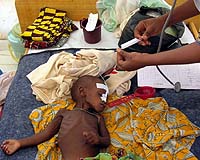
Inmarsat-sponsored aid agency Telecoms Sans Frontieres (TSF) is working with the Niger government to create an early warning system – based on Inmarsat mobile satellite communications – to avert a future crisis in the famine-hit country.
TSF and Inmarsat are currently in talks with the European Commission (EC), the United Nations Development Programme (UNDP) and other international organizations to set up a network of 112 R-BGAN terminals across remote areas of Niger.
Information network
The aim is to alert the authorities of impending food and water shortages and avoid a disaster on the scale seen in the country earlier this year.
Using the Inmarsat R-BGAN terminals, the proposal is to create an information network that links all the remote areas in the African country with the local authorities in the capital of Niamey.
Real time transmission
By equipping 112 identified points in isolated areas with R-BGAN terminals, information on stock availability, harvests, local prices and family income can be transmitted in real time to the capital.
Currently it can take information – dispatched by bicycle or camel from these remote areas – more than three weeks to arrive in the capital, by which time people are already dying.
Facing starvation
Niger – a vast, arid African country, located on the edge of the Sahara desert – is currently suffering from drought and severe food shortages affecting at least 2.5 million people. Some 150,000 children alone are said to be facing starvation.
Massive amounts of foreign aid have flowed into Niger since the world woke up to the crisis, but the food has not yet reached around a million people.
And while in some areas, this autumn’s harvests are under way and look more promising than last year’s, TSF says the situation is still alarming.
Making a difference
Inmarsat chairman Andrew Sukawaty said: “I know everyone at Inmarsat wishes this programme to be a success. We hope – with our partners – to make a difference in one of the poorest countries on the planet.”
