

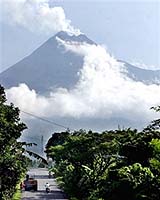
Residents living near Indonesia’s Mount Merapi volcano will be evacuated starting next week amid fears of a new eruption, an official said Saturday. On Friday about 100 people from the village closest to Merapi were moved two kilometres (about one mile) away after the volcano started rumbling and spewing smoke.
“We have prepared everything,” said district chief Sukarno, who only uses one name.
He said next week officials will send children, women and the elderly to a relocation center built in 1995 some six kilometres away.
At least 64 people in the village were killed by a cloud of heat when Merapi erupted in 1994, the official said. The eruption also forced 6,000 others to evacuate.
The mountain last emitted smoke and lava in 2001 but there was no major eruption. About 12,000 people live in the area.
A vulcanologist monitoring Merapi, Dewi Sri, said a code red, the highest volcanic alert level which would trigger a mandatory evacuation, was only a matter of time.
“The status will increase to a code red,” she was quoted as saying by the state Antara news agency.
Sukarno said the first phase of evacuation would also include moving cattle and poultry to safer places.
“We don’t want cattle to keep people from relocating,” he said.
Vulcanologists placed a “standby” alert on Merapi last week, one level below the highest alert status.
Many people living in the slopes of the 2,914-metre (9,616-foot) volcano have refused to evacuate their villages despite warnings.
Traditional beliefs hold that Merapi will only erupt after certain omens, some of which appear in dreams.
Authorities have prepared for an eruption by staging evacuation drills, setting up relief teams, making shelters and stockpiling food and medicine.
Merapi, which has been rumbling intermittently over the past four years, looms above a plain located in the southern area of Central Java province, north of the cultural city of Yogyakarta.
Indonesia sits on the Pacific “Ring of Fire” noted for its volcanic and seismic activity. The country has more than 100 active volcanoes.
In August 1883, the biggest natural phenomenon ever seen on earth took place when after lying dormant for 300 years Krakatoa volcano burst to life, showering debris on Java and Sumatra islands and killing about 36,000 people.
Source: Agence France-Presse
