
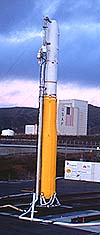
Orbital Sciences Corporation announced today that it successfully carried out the inaugural launch of the U.S. Air Force’s new Orbital/Suborbital Program (OSP) space launch vehicle, delivering 11 satellites and two scientific experiments into their targeted orbits.
The mission originated from Vandenberg Air Force Base (VAFB), California last night (January 26, 2000) at 10:03 p.m. EST when the OSP rocket lifted off from Spaceport System International’s new commercial launch pad, commencing its first flight into low-Earth orbit.
Approximately 13 minutes later, the OSP vehicle began deploying its multiple satellite payloads into orbit at an altitude of approximately 405 nautical miles above the Earth.
“After three consecutive years of near flawless performance from 1997 to 1999, we are delighted to begin our 2000 launch activities with another successful mission, especially with the first flight of the OSP rocket,” said Mr. Ron Grabe, Executive Vice President and General Manager of Orbital’s Launch Systems Group.
“We are extremely proud of the work we have done on this program for the Air Force, which has given the nation an entirely new space launch capability.”
The OSP mission was Orbital’s third space launch in less than two months, using three different types of company-built rockets. On December 4, Orbital’s air-launched Pegasus rocket carried seven ORBCOMM satellites to their proper orbit, and then on December 20 its ground-launched Taurus rocket launched the Republic of Korea’s KOMPSAT satellite and NASA’s ACRIMSAT spacecraft.
In total, over the past two months, Orbital successfully conducted three space launch missions, using three different vehicle configurations that deployed 20 satellites, eight of which were built by the company.
