
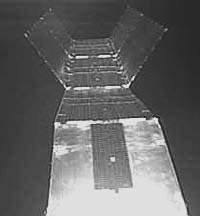
For the first time from space, video images have been captured of a commercial satellite unfolding its purple-hued solar wings in orbit more than 22,000 miles above Earth. When extended, the wingspan of the satellite approximates that of a Boeing 737 jetliner.
The images of the solar wings were radioed from the first Hughes HS 702, the largest, most powerful commercial satellite ever launched. The HS 702 satellite is built by Hughes Space and Communications Company (HSC), the world’s leading supplier of communications satellites.
“We are extremely proud of the success of our first HS 702, as it opens a new era in high-power commercial spacecraft,” said Tig Krekel, President and Chief Executive Officer of HSC.
“But even more impressive is the ingenuity of our technical team in devising a means to capture video of this technological first. It’s the stuff of which history is made, and it’s the stuff on which HSC is based,” added Krekel.
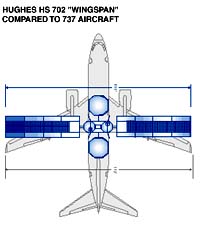 Two video cameras specially modified to withstand the rigors of a rocket launch and the extreme temperature variances in space captured the 30-minute-long milestone sequence of the spacecraft’s uniquely designed solar wings unfolding, panel by panel, until the satellite reached its full wingspan of 111 feet.
The HS 702 solar wings carry angled solar reflector panels along each side that concentrate more of the sun’s rays onto the solar cells in order to generate increased power.
The gallium arsenide solar cells are among the most efficient available, able to convert nearly 25 percent of the sun’s rays into spacecraft power. The satellite, Galaxy XI, was built by HSC for PanAmSat Corporation and was launched on an Ariane rocket on Dec. 21, 1999.
The HS 702 model spacecraft was introduced in 1995 to meet customer requirements for satellites with more than 10 kilowatts of power, and with flexible payload capacity.
A total of nine of these powerhouses have been ordered by such customers as PanAmSat Corporation, XM Satellite Radio, Telesat Canada, and Hughes Spaceway(tm). This year three more HS 702s, with power ranging up to 18 kilowatts at beginning of life, are scheduled to launch.
Building on this strong foundation, HSC announced the enhanced HS 702+ spacecraft model in October 1999, designed with the industry-first ability to achieve 25 kilowatts of power.
The solar wings were designed and manufactured by Spectrolab, Inc., a unit of Hughes Electronics Corporation. Spectrolab, founded in 1956, has been supplying solar cells and panels to the space industry for 40 years and is also a leading supplier of searchlights and solar simulators. Hughes Electronics Corporation acquired Spectrolab in 1975.
