
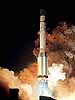
Hughes Space and Communications Co. will close out 1997 with the launch of AsiaSat 3, a high-power satellite built for Asia Satellite Telecommunications Co. Limited, or AsiaSat, Tuesday morning, Dec. 23, from the Baikonur Cosmodrome in Kazakhstan.
It is the second spacecraft supplied by Hughes to Hong Kong-based AsiaSat. The launch is the ninth and last for Hughes this year, and is also the company’s fourth launch in the month of December. AsiaSat 3 is scheduled for launch on a Proton rocket at 4:18 a.m. Tuesday (3:18 p.m. Monday in Los Angeles, 11:18 p.m. Monday GMT).
“This year has been a busy one for us here at Hughes, but it’s also been an exciting one,” said Donald L. Cromer, president of Hughes Space and Communications Co.
“In 1997 we saw the launch of our first high-power HS 601HP satellite. As the year draws to a close, we will have launched four of these powerful spacecraft, which feature duel-junction gallium arsenide solar cells and an optional xenon ion propulsion system, the world’s first commercially available xenon ion propulsion system. We will begin 1998 with a backlog of approximately 36 satellites, and by the year’s end, we will launch our newest and most powerful yet, the HS 702.”
AsiaSat 3 is an HS 601HP or high-power satellite, featuring 9900
watts of power. It will increase AsiaSat’s capacity to distribute
television and telecommunications services to Asia, the Middle East,
Australasia and the Commonwealth of Independent States.
The satellite will carry 28 active C-band transponders using
55-watt traveling wave tube amplifiers (TWTAs). It will also carry
16 active Ku-band transponders using 138-watt TWTAs. These
transponders will operate through two 107-inch-diameter shaped
surface antennas.
One antenna, mounted on the east side of the satellite and
operating in C-band, will provide broad-band coverage of Asia and
Australasia. The west-side antenna will operate in Ku-band and
provide focused area coverage of East Asia.
A 50-inch diameter, dual-gridded shaped surface antenna,
operating in Ku-band, will provide focused area coverage of South
Asia. In addition, a 40-inch-diameter Ku-band steerable spot-beam
antenna will allow AsiaSat 3 to direct coverage to any area on the
Earth’s surface which is visible from the spacecraft’s orbital
location of 105.5 degrees East longitude.
AsiaSat 3 is designed for 15 years of service after delivery
in-orbit. It will join AsiaSat 1, an HS 376 spin-stabilized
spacecraft, also built by Hughes and launched in 1990. Both
satellites are controlled from an integrated satellite control
facility in Hong Kong, which was also built by Hughes.
