

The most senior North Korean delegation to visit South Korea in more than a year was expected here Tuesday for talks officials hoped could ease the nuclear standoff and Pyongyang’s international isolation, officials said here.
The North Korean cabinet-level delegation was due to arrive at Incheon International Airport, west of Seoul, on a direct flight from Pyongyang for talks which will last until Friday, Seoul’s unification ministry said.
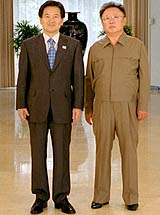
The talks are seen as a follow-up to North Korean leader Kim Jong-Il’s meeting on Friday in Pyongyang with Chung Dong-Young, South Korea’s unification minister.
Kim told Chung North Korea would return to the stalled six-way nuclear disarmament talks as early as July if Washington “recognizes and respects” his country.
Chung is at the head of the South Korean delegation to the ministerial talks which are to focus on North Korea’s nuclear drive and also boosting inter-Korean exchanges, the ministry said.
“Both South and North Korea have higher expectations for the talks than ever,” said Jun Byung-Hun, spokesman for South Korea’s ruling Uri Party.
“We hope the reconciliatory and cooperative atmosphere of the Kim-Chung meeting will systematically take root and lead to more practical agreements through the talks.”
Seoul officials hope the North Korean delegation led by Kwon Ho-Ung, a senior cabinet councillor, will offer more concrete signals concerning a return to the nuclear disarmament talks.
Since last June, North Korea has boycotted the six-way talks that also include the United States, South Korea, Russia, Japan and China. On February 10 it declared that it possesses nuclear weapons.
The annual US-EU summit on Monday issued a joint statement urging North Korea to end its nuclear weapons and reaffirmed support for six-nation talks on the North’s atomic program.
“The DPRK (North Korea) must comply fully with its non-proliferation obligations, and dismantle its nuclear weapons and nuclear weapons programs in a permanent, transparent, thorough, and verifiable manner,” it read.
Japan and South Korea also on Monday called for a swift resumption of stalled talks on North Korea’s nuclear weapons program.
Washington has responded to Kim’s proposal to return to talks in July by asking for a concrete date.
“Until we have a date, unless we have a date, we don’t have talks,” said assistant secretary of state Christopher Hill, the US top negotiator with North Korea, on Monday.
Experts cautioned that North Korea could side-step the nuclear issue at the cabinet-level talks. In the past the Stalinist state has said the nuclear issue was not a matter for inter-Korean dialogue which should focus on economic exchanges.
During the four-day talks, the two Koreas are expected to hammer out concrete follow-up schedules for accords on inter-Korean matters agreed by Chung and Kim in Pyongyang on June 17, officials said.
Kim and Chung agreed to arrange more reunions of separated families in August and resume general-level military talks. They also agreed to push for inter-Korean fisheries talks and regular direct air routes.
Also put on the agenda at the cabinet-level talks was a request for Japan to repatriate to North Korea an 18th-century stone monument which was seized by Tokyo in 1905.
The talks will also likely address the impoverished North’s request last week for an additional 150,000 tonnes of fertilizer aid from the South. Seoul donated 200,000 tonnes of fertilizer last month.
The two sides will also discuss ways to boost inter-Korean rapprochement projects including the development of a joint industrial site in the North and the relinking of cross-border railways.
The two Koreas have remained technically at war since the 1950-1953 Korean conflict ended in an armistice, not a permanent peace treaty.
Icy relations have been slowly thawing since their leaders held an unprecedented peace summit in 2000.
