
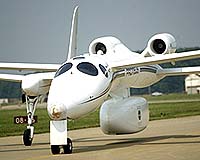
Scientists at NASA Langley Research Center are relying on a futuristic-looking aircraft to help measure movements of pollution from a unique vantage point ¿ about 10 miles high.
The high-altitude Proteus research aircraft from Scaled Composites, LLC, of Mojave, Calif., taxis toward takeoff in support of NASA Langley’s involvement in the Intercontinental Chemical Transport Experiment – North America (INTEX-NA). The Proteus carries a Langley instrument payload to support the study. INTEX-NA is measuring pollution movement around the globe.
As part of a multi-agency effort to track air quality, NASA researchers are participating in the Intercontinental Chemical Transport Experiment-North America (INTEX-NA) that will measure the movements of pollution around the globe as part of a joint regional air-quality and climate study running through August 19.
The high-altitude Proteus research aircraft from Scaled Composites, LLC, of Mojave, Calif., which holds several sustained altitude records, will carry a NASA Langley instrument payload to support the study.
The instrument suite on Proteus includes the National Polar Orbiting Environmental Satellite System (NPOESS) Atmospheric Sounder Test-bed Interferometer (NAST-I).
The NAST-I instrument scans the atmosphere from beneath aircraft, providing detailed characteristics of the atmosphere and land surface, and atmospheric temperature and water vapor profiles. NAST activities prepare for operations of future Earth observing satellite instruments.
In addition, a new instrument system from NASA Langley and a Virginia Space Grant Consortium (VSGC) team – MicroMAPS (Measurement of Air Pollution from Satellites) is also on Proteus supporting INTEX-NA.
MicroMAPS, which measures carbon monoxide in the atmosphere, was recently flight-tested for the first time on Proteus and is a VSGC coordinated effort involving students and faculty from Virginia Tech, Old Dominion University and the University of Virginia.
