
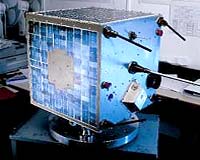
Satellites the size of Gurwin TechSat II typically stay in space for one to two years, but this mostly student- built satellite has exceeded expectations as it starts its fourth year inorbit. At the same time, the Technion-Israel Institute of Technology satellite serves as the foundation for an agreement with Cornell University researchers to test new control methods.
Technion and Cornell researchers have developed small spacecraft attitude controllers — which regulate the direction the satellite points and improve their efficiency — specifically designed for less expensive, lighter small spacecrafts. The controllers are to be tested in the winter and spring of 2002 on the Gurwin TechSat II, considered ideal for the tests because of its small size (106 pounds). If the control methods work, they may be used in the next generation of U.S. satellites.
“When you are in space, it’s very difficult to tell which way you are pointing, and especially difficult to be oriented in the right direction” according to attitude specialist Professor Mark L. Psiaki of Cornell’s Mechanical and Aerospace Engineering Department. “We are pursuing this vital field because new developments are needed to make the use of these small satellites more economical. It would take much more money — and a larger satellite — to use the existing hardware.”
Prof. Psiaki, a visiting professor at the Technion in 1994-95 and again in 2001, is working with Technion professor Moshe Guelman, head of the Asher Space Research Institute (ASRI). Prof. Guelman has been working on the satellite since it was launched in 1998. At the time, the satellite was the least expensive, smallest satellite of its kind, and the lowest power consumer. Philanthropist Joseph Gurwin of Long Island, N.Y. funded the project.
