
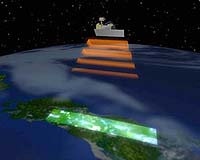
Goodrich Corporation’s imaging technology is enabling Japan’s newly launched Advanced Land Observation Satellite to carry out its remote-sensing mission. Goodrich’s Electro-Optical Systems team developed the advanced high precision optical systems in ALOS’s three Panchromatic Remote-sensing Instrument of Stereo Mapping, or PRISM, telescopes.
Each telescope has a unique optical configuration allowing it to capture large areas of the ground. The mirrors for each system are a maximum of 0.6-meters (23 inches) in diameter and polished to a surface precision better than 10 billionths of a meter.
The company’s Electro-Optical Systems team also provided the attitude-control hardware that supports precision pointing of ALOS toward specific regions on Earth. The hardware incorporates Goodrich proprietary fine-balancing processes the company said will “dramatically reduce the disturbances imparted to the satellite.”
Developed by JAXA, the four-ton (3,750 kilogram) ALOS is one of the largest Japanese satellites ever sent into space. Launched on Jan. 24, its main imaging tasks during its three-year mission will be handled by the PRISM instruments, which can identify objects on Earth as small as 2.5-meters to support precision mapping.
PRISM has three Goodrich-produced optical sensors pointing forward, down and backward along the craft’s ground track. The arrangement provides high quality, three-dimensional imagery and can collect image areas up to 70 kilometers (45 miles) wide.
ALOS will aid natural resource assessments, help cartographers to create more precise maps, and support disaster responses.
