
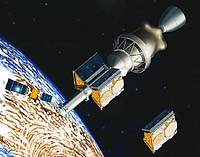
Globalstar, which lost billions of dollars creating a worldwide satellite telecom network, announced it was emerging from bankruptcy with a new owner. Globalstar, which had been backed by a powerful international consortium headed by Loral Space, will be transferred to Thermo Capital Partners LLC, a private investor firm with offices in New Orleans, Louisiana, and Denver, Colorado.
Globalstar was established with ambitious goal of offering global wireless telephone service to virtually all populated areas of the world through a network of 24 low-orbiting satellites.
But making such a service profitable has been challenging as traditional wireless telephones have improved and costs have come down.
A similar service, Iridium, flopped in 1999 after investors poured five billion dollars into the venture. The Iridium assets were bought in bankruptcy for 25 million dollars and relaunched in 2001.
Under a plan approved by the US Bankruptcy Court in Delaware last week, Thermo will own 81.25 percent of the new company that will eventually take control of substantially all of Globalstar’s assets and operations for 43 million dollars.
The remaining 18.75 percent of the shares will be retained by Globalstar for distribution to its creditors under its bankruptcy plan.
Additionally, Globalstar’s creditors will have the right to purchase additional shares that could give them up to 36.37 percent of the firm’s stock.
“This is the beginning of a new, very encouraging chapter for Globalstar,” said Globalstar president Tony Navarra.
“Our working relationship with Thermo has already spanned many months, and as a result, we have been able to rapidly develop with them an outline for an aggressive business plan that will give Globalstar the opportunity to broaden our business and to introduce new products and services in the future.”
Before its bankruptcy, Globalstar was a 3.3-billion-dollar project backed by Italy’s Alenia, China Telecom, DaimlerChrysler Aerospace, Finland’s Elsacom, South Korea’s Hyundai, France Telecom, Alcatel and Britain’s Vodafone.
Globalstar claims to be the world’s most widely-used handheld satellite phone service, offering both voice and data services from over 100 countries around the world.
But as traditional mobile phone services have expanded, satellite phone service has been relegated to a more limited market, such as maritime or air service and communications in remote areas not served by terrestrial wireless networks.
Under the new plan, Globalstar said service and customer support would continue uninterrupted, and the new company would introduce “an accelerated business expansion plan” in 2004.
“Even in the midst of this challenging restructuring process, Globalstar has been able to achieve truly astounding growth, opening up many new markets and more than tripling our subscriber base since our restructuring work first began,” Navarra said.
“With this process now almost complete, we should be able to accelerate our business growth even further, reinforcing the company’s leadership in the mobile satellite phone industry.”
