
Researchers said their computer simulation shows rocks that exist at temperatures and pressures likely to exist at the cores of Jupiter, Saturn and giant extrasolar planets exhibit electric conductivity. The researchers – Renata Wentzcovitch and Koichiro Umemoto at the University of Minnesota, and Philip B. Allen of Stony Brook University in New York – said the model creates rocks in these environments that are considerably different from those on Earth.
They have metallic-like electric and thermal conductivity, properties that can produce longer-lasting magnetic fields, enhanced heat flow to the planetary surfaces and intense quakes and volcanic activity.
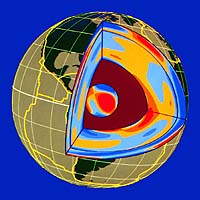
Wentzcovitch and colleagues studied a section of Earth’s core called the D” layer (pronounced “D double prime”), a variable zone that runs from zero to 186 miles thick, surrounding the iron core and lying just below the mantle. Like the mantle, the D” layer consists mainly of a mineral called perovskite, comprising magnesium, silicon and oxygen – except at this depth, temperatures and pressures alter the structure of the perovskite crystals, transforming the mineral into something the researchers call “post-perovskite.”
Writing in the Feb. 17 issue of the journal Science, the researchers said they focused on the cores of the local gas-giant planets – Jupiter, Saturn, Uranus and Neptune – as well as two recently discovered exoplanets found elsewhere in the Milky Way. One, called Super-Earth, is about seven times Earth’s mass and orbits a star 15 light-years away in the constellation Aquarius. The other, called Dense-Saturn, has about the same mass as Saturn, and orbits a star 257 light-years away in the constellation Hercules.
Wentzcovitch’s team calculated what would happen at temperatures and pressures likely near the cores of Jupiter, Saturn and the two exoplanets, where temperatures run close to 18,000 degrees Fahrenheit (10,000 degrees Celsius) and pressures reach 10 million bars (10 million times atmospheric pressure at sea level). They found even post-perovskite could not withstand such conditions, and its crystals dissociated into two new forms.
The researchers discovered one form began behaving like a metal, with its constituent electrons becoming very mobile and able to conduct electric current. The effect would be to support the planet’s magnetic field, if it has one, and inhibit reversals of the field’s poles. The increased electrical activity also would help transport energy out of the core and toward the planet’s surface, where it would cause severe quakes and volcanic eruptions. The effect would be much stronger in Dense-Saturn than in Super-Earth, they wrote.
The interiors of the icy giants Uranus and Neptune don’t exhibit such extremes of temperature and pressure, so post-perovskite would survive in their cores without becoming metallic, Wentzcovitch said. “We need to understand how (giant planet) interiors behave under these extreme pressure and temperature conditions. Only then it will be possible to model them.”
She said the findings should advance the field of comparative planetology, because “we will understand Earth better if we can see it in the context of a variety of different kinds of planets.”
