
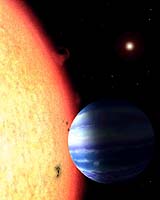
A European team of astronomers has discovered a planet only 14 times more massive than the Earth. This is the smallest extra-solar planet discovered so far, and it lies at the threshold of the largest possible rocky planets, making it a possible super Earth-like object.
Uranus, the smallest of the giant planets in our solar system, has a similar mass. However Uranus and the new exoplanet differ in their distance from the host star, so their formation processes and structures are likely to be very different.
Only 0.09 AU away from its star mu Arae, the planet completes an orbit in 9.5 days. Uranus, in comparison, is over 19 AU from the sun, and completes an orbit in 30,685.4 Earth days (84 years).
The solar-like star mu Arae is about 50 light years away, and is located in the southern constellation Ara (the Altar). A 5th magnitude star, it is bright enough to be observed with the unaided eye.
Two Jupiter-sized planets already had been detected orbiting mu Arae. The planet designated “b” is at least 1.7 times Jupiter’s mass, and orbits the star at an average distance of 1.5 AU. This planet is in a highly elliptical orbit that takes about 638 days to complete.
Planetary candidate “c” is about 1 Jupiter mass, and is 2.3 AU from Mu Arae. This planet has an extremely eccentric orbit that takes roughly 1,300 days to complete.
The newest planet discovery was made with the HARPS spectrograph on ESO’s 3.6-m telescope at La Silla. This spectrograph allows radial velocities to be measured with a precision better than 1 m/s.
Since the first detection of a planet around a star other than our sun, astronomers have learned that our solar system is not unique. We currently know of more than 120 giant planets orbiting other stars.
Most of these planets were discovered by radial-velocity surveys, an observational method based on perceived variations in the light of the central star, caused to the gravitational pull exerted by an orbiting planet.
The measured velocity variations allow scientists to deduce the planet’s orbit and minimum mass.
During eight nights in June 2004, mu Arae was repeatedly observed and its radial velocity measured by HARPS to obtain information on the interior of the star.
This “astero-seismology” technique studies the small acoustic waves that make the surface of the star periodically pulsate.
By learning about the internal structure of this star, astronomers hope to understand the origin of the unusual amount of heavy elements observed in its stellar atmosphere. This unusual chemical composition also could provide information about the planet’s formation history.
Astronomers can only speculate on the true nature of the planet. Giant planets are thought to form by first developing a core through the accretion of solid “planetesimals.”
Once this core reaches a critical mass, gas accumulates in a runaway fashion, and the mass of the planet increases rapidly. In the present case, the runaway gas accumulation must not have happened – otherwise the planet would be much more massive.
This object is likely to be a planet with a rocky core, surrounded by a small gaseous envelope that is only a tenth of the planet’s total mass. This planet therefore could qualify as a “super-Earth.”
The detection of this new planet demonstrates the potential of HARPS for detecting rocky planets on short orbits.
HARPS could make possible the detection of big “telluric” planets that are only a few times the mass of the Earth. Detection of such rocky objects by HARPS would allow missions like COROT, Eddington and KEPLER to measure their radius.
