
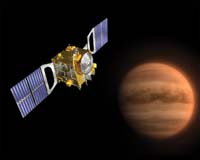
ESA has established the Venus Amateur Observing Project to obtain high-quality images of the planet to supplement the work of its Venus Express spacecraft, which will enter orbit next month and begin its science mission in May.
The ground-observations campaign includes obtaining routine images of Venus during each appearance, and co-ordinated observations during specific moments of the mission to provide simultaneous or data complementary to the spacecraft observations.
The VAOP “is an opportunity to contribute scientifically useful images and data to complement the Venus Express spacecraft observations,” ESA said in a statement. The space agency particularly wants to use the capabilities of “advanced amateurs” to obtain images of the Venusian atmosphere, such as specially filtered monochrome images obtained with CCD based cameras in the 350 nanometer to 1000 nanometer wavelengths in the near-ultraviolet, visible and near-infrared ranges.
Venus Express, or VEX, will observe the planet using seven instruments for at least two Venusian years about 1,000 days. The instrument package includes the Venus Imaging Camera, called the VMC, which will image the planet in the near-UV, visible and near-IR range. Although VMC will provide much higher resolution images of the planet than visible from Earth, continuous monitoring will not be possible there may be periods when parts of the planet are visible from Earth but not from the spacecraft, due to its position in orbit.
Also, ESA scientists think it is important to compare Earth-based observations with simultaneous spacecraft observations. “This will allow us to extend our understanding of the dynamics of Venus’s atmosphere based on the VEX data to observations made prior to the VEX mission, as well as after completion of VEX operations,” ESA said.
