
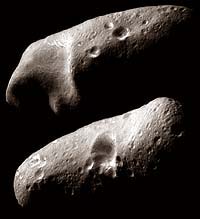
Last week the NEAR spacecraft obtained a sequence of image mosaics showing Eros’ surface as the asteroid rotated under the spacecraft.
At that time the range to the surface was approximately 355 kilometers (220 miles). These two mosaics, part of that sequence, show the stark beauty of the two opposite hemispheres. The smallest detail visible is 35 meters (120 feet) across.
The top mosaic shows wavy brightness banding exposed in the interior walls of the saddle. In the bottom mosaic, similar banding is visible in one of the craters near the limb at left. To the right, the angle of the illumination accentuates the quasi-linear troughs near the terminator.
Successful firing of NEAR’s thrusters yesterday, February 24, placed the spacecraft on course for insertion into the next lower orbit, at a 200 kilometer (120 mile) altitude. Images from that orbit, commencing in early March, will have nearly twice the spatial resolution of data returned so far.
 On 12 February, 2000, the NEAR spacecraft obtained a sequence of 780 images of Eros from a range of about 1800 km (1100 miles). This sequence covered one complete revolution of the asteroid at 0.5 degree intervals. In these views of opposite hemispheres of the asteroid (seen right), groups of images slightly apart in time were digitally processed to bring out local details.
The processed data showing Eros from slightly different perspectives can then be combined as anaglyphs or stereo pairs. The processing of the data highlights the topography of small-scale features, but makes the gross shape of the asteroid appear flattened.

