
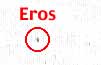
This first image of the asteroid 433 Eros was acquired by the multispectral imager on the Near Earth Asteroid Rendezvous (NEAR) Spacecraft on November 5, 1998, at a distance of 2.5 million miles (4 million kilometers) from the asteroid. Eros, located at the center of the image and circled, appears against the star background in a single illuminated pixel. Click on Eros pix for larger sky view as seen from NEAR with location of major stars
At the time of the image, NEAR was located 200 million miles (321 million kilometers) from Earth, and the radio signal which transmitted the image from the spacecraft took nearly 18 minutes to reach Earth. The image is a part of a 5.3-hour sequence of images that show Eros over one full rotation of the asteroid.
Repeated imaging of Eros through January will be used to refine knowledge of NEAR’s trajectory relative to the asteroid, to plan firings of the spacecraft’s engines to slow the craft and place it into orbit. Currently, NEAR is approaching Eros at a rate of 2100 miles per hour (945 meters per second).
Three firings of NEAR’s engines, beginning on December 20, 1998, will slow spacecraft velocity relative to the asteroid to near 10 miles per hour (5 meters per second) at Eros orbit insertion on January 10, 1999.
 NEAR was launched on February 17, 1996. On June 27, 1997, it passed within 1200 kilometers (750 miles) of asteroid 253 Mathilde, the first dark, primitive asteroid visited by a spacecraft. On January 23, 1998, a close encounter with Earth bent the spacecraft’s trajectory out of the orbital plane of the major planets, and directed it toward Eros. After Eros orbit insertion, NEAR will conduct the first-ever comprehensive study of a near-earth asteroid for over one year.
Jim Benson CEO of SpaceDev Inc, which is planning its own privately funded mission to a near earth asteroid, said “The Johns Hopkins NEAR mission is important because it is helping to validate NASA Administrator Dan Goldin’s new philosophy of “better, faster, cheaper” missions, by cutting deep space science missions from billions to only a few hundred million dollars.
However, an important difference between NASA’s NEAR mission to Eros and SpaceDev’s Near Earth Asteroid Prospector (NEAP) mission to Nereus, is that NEAP is designed to drop instruments to the surface of its target asteroid, Nereus, which may be carbonaceous or metallic.
“I believe we are at the beginning of the space commercialization
revolution, and that it will last throughout the new millennium, and
that it will create more jobs and economic opportunities than any
prior phase of the ongoing Industrial Revolution,” added Benson.
NEAR Reports At SpaceDaily
SpaceDev Articles
Asteroid and Other Debris at Spacer.Com
