
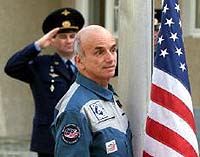
The US space shuttle Endeavour will return to earth two days later than planned, due to the computer failures aboard the International Space Station, and that will mean space tourist Dennis Tito will have to delay his own trip, a NASA spokeswoman said Thursday.
The computer problems aboard the ISS had not been fixed by late Thursday, while a backup system was also inoperable, said Greg Lang, spokesman at the Johnson Space Center in Houston, Texas.
NASA has therefore decided to delay the shuttle’s return to Cape Canaveral, Florida on Wednesday May 2, instead of Monday April 30, as originally planned.
Because of the changes, NASA has contacted the Russian space agency to set a new date for the launch of their rocket carrying US businessman Tito into space, Lang said.
Tito, 60, was originally scheduled to blast off on Saturday from Kazakhstan’s Baikonur space center after Russia’s US, European and Japanese partners gave their go-ahead to the controversial mission earlier in the week.
Tito is paying Russia 20 million dollars for his ISS ticket, becoming the first person to personally finance a mission into outer space. He was scheduled to play no operational role on the 10-day flight to and back from the ISS.
The onboard computer problems, which began Wednesday and are of unknown origin also forced a delay of several days in planned work with the Canadian-built Canadarm2 robotic arm, which was attached to the Destiny space laboratory at the weekend.
On Thursday, the Endeavour and ISS crew continued to unload the Italian reusable cargo carrier Raffaello, which was laden with some three tonnes of equipment for the mission and for scientific experiments.
Meanwhile as Tito prepares for the thrill of a lifetime, it’s business as usual for his fellow crewmembers, cosmonauts Yury Baturin and Talgat Musabayev.
Whereas Tito is paying the Russian Space Agency 20 million dollars for his one-off flight into space, his companions will by flying for free, and receiving their regular airforce pay for the privilege.
Baturin, at 51, is nine years younger than his passenger. He made his first space flight in August 1998 but had been involved in the space industry as an engineer, and subsequently as an advisor to former president Boris Yeltsin, for 30 years previously.
“Far from the Earth, you start to think differently about the meaning of life,” he told AFP in the runup to the flight.
Though passionate about the prospect of flying in space, his early ambitions were squashed on health grounds, and it took him more than 25 years of persistent efforts before he got the nod three years ago.
Baturin is flight engineer for Saturday’s trip to the International Space Station, under the command of Musabayev, who is one year his junior.
Of Kazakh origin, Musabayev is a veteran with 333 days of space travel under his belt.
During his two missions aboard the Mir space station in 1994 and 1998 he made two space-walks totalling 42 hours.
He too has been part of the space and aviation industry for most of his adult life.
Initially an engineer, he began training to become a pilot at the age of 26, and became the first Kazakh to receive a “master pilot” title in 1982.
He began training for space missions in 1990 and went on to become Kazakhstan’s second cosmonaut.
He will play no operational role during his 10-day flight to and back from the ISS.
But Tito says his upcoming space flight is not simply a costly voyage, but the start of a career, the first space tourist Dennis Tito, a U.S. citizen who is completing preparations for a mission to the International Space Station, told the press on Wednesday.
Tito knows full well that he is not likely to become an astronaut, but he intends to help those who dream of space flight. His flight will serve NASA well and earn it good publicity, Tito thinks.
