

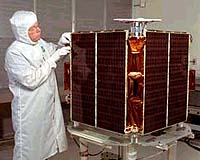
DARPASAT, a microsatellite built by Ball Aerospace & Technologies Corp. and launched in 1994, recently re-entered the atmosphere after more than eight years in orbit. The DARPASAT was an innovative, 198 kg spin-stabilized, inertially oriented satellite experiment designed to demonstrate advanced technology. Ball Aerospace designed, fabricated, integrated and tested the spacecraft bus, and integrated two government-supplied payloads. One of those payloads was a GPS receiver.
Designed for a 1-year demonstration with a government-supplied payload, DARPASAT incorporated and validated several new technologies. The design lifetime goal for DARPASAT was 3 years; however, the satellite surpassed that goal and passed the 8-year milestone in March 2002. Its long life is a result of careful management of battery life and thermal loads. DARPASAT re-entered the atmosphere early in May 2002 due solely to orbit decay, or drag due to expanded atmosphere from solar heating.
“DARPASAT’s success is a great achievement for Ball Aerospace and a credit to everyone who worked on the program,” said Mike Cerneck, vice president and general manager, Ball Aerospace Defense Operations. “We are proud to have been part of such an innovative program.”
DARPASAT met and exceeded all operational performance requirements and program objectives, including the use of a minimum support structure, low cost, rapid launch and demonstration of advanced technology. The satellite earned 100 percent of the possible on-orbit incentive fee in its first full year of operation.
Government offices have recognized DARPASAT’s contribution to future operational defense and warfighter efforts.
