

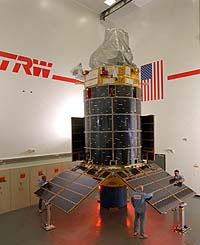
The 21st Defense Support Program (DSP) satellite built by the TRW/Aerojet team is slated for launch on July 27 from a Titan IVB at the Cape Canaveral Air Force Station, Launch Complex 40. The four-hour launch window opens at 4:08 a.m. EDT.
DSP 21 will be launched into a geosynchronous orbit 22,300 miles above the Earth. It will join the existing DSP constellation and provide early warning of strategic and tactical ballistic missile launches to the North American Defense Command and U.S. Space Command centers within Cheyenne Mountain.
TRW and Aerojet have worked together for more than 30 years on DSP. TRW has built 23 DSP spacecraft and integrated 23 missile-detecting infrared sensors built by Aerojet. The DSP system has evolved to meet new mission requirements for the Air Force, continually demonstrating its flexibility and utility, and the satellites have exceeded their specified design lives by 150% through five upgrade programs.
TRW provides end-to-end system support for the DSP program. In addition to building and integrating the spacecraft, TRW provides day-to-day technical assistance at Schriever and Buckley Air Force Bases; performs satellite performance analysis, anomaly resolution and early on-orbit testing at its TRW Orbital Test Station; and has built software systems that help to process, display and distribute DSP data to national command authorities.
Aerojet, besides designing and building the 1,200-pound DSP infrared sensors, provides software systems for ground processing of DSP infrared data. The company developed the Joint Tactical Ground Station, which reports DSP data to theater commanders, and the Attack and Launch Early Reporting to Theater System to analyze DSP data and improve the identification and tracking of ballistic missiles.
TRW and Aerojet are also working on the Space-Based Infrared System Low (SBIRS Low) program, the low-Earth orbiting component of the nation’s next generation missile warning system. TRW is heading the effort to define program requirements, reduce risk and complete conceptual designs. Aerojet’s primary responsibility is providing engineering support for the ground processing segments.
