
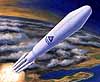
Boeing technicians and U.S. Air Force personnel placed the inaugural Boeing Delta 3 first stage on the launch mount at Cape Canaveral Air Station on May 3.
The launch team transported the first stage from Delta mission checkout to Space Launch Complex (SLC) 17 pad B in preparation for the Delta 3 inaugural launch scheduled for this summer. Boeing modified SLC-17B, to launch both Delta 2 and Delta 3 rockets, in October 1997.
The first Delta 3 will carry a Hughes HS 601-HP communications satellite into geosynchronous transfer orbit (GTO) for PanAmSat.
Boeing developed the Delta 3 to meet the commercial space industry’s growing demand for launch vehicles with an intermediate payload capacity. Delta 3 can carry 8,400 pounds to GTO, more than twice the capacity of the Delta 2. Many of the components from the highly reliable Delta 2 program were incorporated in the design of the Delta 3. These components include the first stage engine and liquid oxygen (LOX) tank, the redundant inertial flight control assembly (RIFCA), and a larger variant of the Delta 2 solid rocket motors.
The first stage of the Delta 3 carries the main engine, the Rocketdyne RS-27, built by Boeing in Canoga Park, Calif., and the liquid oxygen and fuel tanks. Boeing manufactures the liquid oxygen tank in Huntington Beach, Calif., where it also produces the 13.1-foot diameter fairing.
The Delta 3 utilizes the cryogenically powered Pratt and Whitney RLlOB-2 as its second-stage engine which is manufactured in West Palm Beach, Fla. Allied Signal of Teterboro, N.J., provides the RIFCA, and the solid rocket motors are made in Magna, Utah, by Alliant Tech systems.
