

Proxity has announced that operating subsidiary Cyber Defense Systems has entered an agreement with the U.S. Naval Postgraduate School (NPS).
Cyber Defense Systems will transfer two CyberBug UAVs to the NPS in support of the Coalition Operating Area Surveillance & Targeting System (COASTS) program, providing key U.S. Pacific Theater allies an opportunity to test new technologies.
The scheduled exercises are in partnership with the U.S. Pacific Command (USPACOM), Joint U.S. Military Advisor’s Group Thailand (JUSMAGTHAI), Naval Postgraduate School, and Thailand Royal Thai Supreme Command (RTSC), Royal Thai Armed Forces (RTARF), and the Thai Department of Research & Development Office (DRDO).
The NPS will use the COASTS field experiment to develop and test low cost, state-of-the-art, unclassified air and ground wireless sensor mesh networks technologies, providing real-time sensor-to-decision maker information.
COASTS expects to implement the CyberBug in a medium-scale demo that fuses and disseminates air and ground sensor information via an aerial balloon enabled with wireless networking capabilities to both a local and remote C2 center.
In addition, COASTS will demonstrate U.S. ability to operate in partnership with coalition forces, as well as to identify future science and technology research requirements, and specifically to test micro and mini-UAV design and operations.
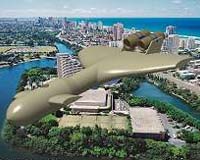
The CyberBug is a low cost UAV developed for the individual user and is a scalable unmanned aircraft. Depending on type of mission, it can weigh between 2.6 pounds to 6 pounds and carry a 5-pound payload. Operating the CyberBug does not require extensive instruction, technical backup or pilot training.
Capable of rapid deployment, it can be assembled and launched by an individual soldier from remote areas in 30 seconds, and easily recovered in winds up to 20 Mph. The unit includes an autopilot as well as data link with GPS overlay.
The CyberBug has two basic uses: short-term flights to operate surveillance in areas of concern using high powered day and night vision when troops are in dangerous situations, and long-term flights for the surveillance of patrol areas up to four hours.
