
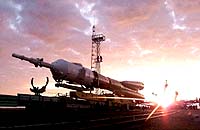
A member of the next planned flight to the International Space Station admitted Tuesday he was nervous about the mission following the explosion of a Russian rocket in mid-air last week, just seconds after blast-off.
“There is nothing worse than waiting,” Russian cosmonaut Sergei Zalyotin told reporters at the Star City training centre near Moscow.
Zalyotin, fellow Russian Yury Lonchakov and Belgian flight engineer Frank DeWinne were due to take off October 28 for the ISS aboard a Soyuz rocket from Baikonur, in neighbouring Kazakhstan, but their mission has been delayed following the blast.
A similar Soyuz-U rocket model blew up last Wednesday while launching a Foton-M satellite from Russia’s Plesetsk military cosmodrome, killing one and injuring 20.
The mission is now expected to take off October 30, but the official launch date is only due to be annonced Wednesday, according to Russian Space Agency spokesman Sergei Gorbunov.
“This uncertainty has a certain influence on the atmosphere among the crew,” Zalyotin added.
This next mission presents an extra challenge for the crew members since it is introducing the Soyuz-TMA vessel on its first-ever trip to the ISS.
The flight will be the second time Belgium sends a cosmonaut into space and the first mission with Russia. Belgian ambassador to Moscow Andre Mernier said Belgium was keen to “benefit from Russia’s considerable scientific experience”.
De Winne meanwhile spoke confidently about the mission, saying the team planned to bringalong Belgian chocolates as a present for colleagues permanently based at the ISS.
Russian aerospace officials quoted by the ITAR-TASS news agency blamed last week’s blast on a manufacturing error.
Russia is one of 16 countries in the ISS project, including Canada, France, Japan, Russia and the United States. It makes all its flights to the orbiting space station on Soyuz rockets.
The head of the European Space Agency (ESA) mission in Moscow, Alain Fournier-Sicre, meanwhile said the ESA would not stop developing its cooperation with Russia because of one failure.
