

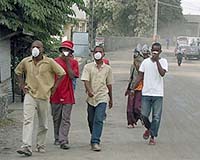
Comoros authorities warned nervous residents in the shadow of the Indian Ocean archipelago’s only active volcano to be on alert on Tuesday as lava continued to simmer in Mount Karthala’s main crater.
Scientists said there was no sign that volcanic activity on the mountain had abated two days after it first spit up smoke and jets of molten rock into its crater, creating eerily glowing red clouds in the night skies over the capital.
“People should be on the alert because any scenario is possible,” said police commander Noaufal Boina, head of the Comoros national emergency center.
Vulcanologists said the activity remained confined to the Chahale crater which was not yet threatening to spill over but warned that Mount Karthala could still erupt in earnest with potential threats from lava, ash and poisonous gas.
Hamidou Nassor of the Mount Karthala National Observatory expressed concern about “possible explosions if the magma comes into contact with water.”
While eyeing the mountain warily, villagers in the foothills of the volcano remained at home Tuesday and went about business as usual, as did residents of Moroni, just 15 kilometers (nine miles) away.
The 2,361-meter (7,746-foot) volcano on the main island of Grand Comore last erupted in November spewed huge plumes of ash that blanketed the isle and temporarily deprived its 250,000 inhabitants of potable water.
Last April, nearly 10,000 villagers living at the base of the mountain fled their homes after similar emissions of ash sparked widespread fears of drinking water contamination.
Mount Karthala last had a magma eruption in 1977, when lava destroyed the village of Singani, some 20 kilometres south of Moroni, and toxic gas was released into the air but did not cause any deaths.
