
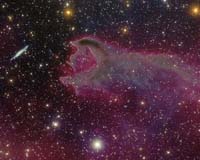
A dramatic new view of the cometary globule CG4 marks the one-thousandth image posted to the online gallery hosted by the National Optical Astronomy Observatory.
The flower-like image of this star-forming region in Earth’s southern skies was taken by Travis Rector and Tim Abbott using a 64-megapixel Mosaic imaging camera on the National Science Foundation’s Victor M. Blanco telescope at Cerro Tololo Inter-American Observatory in Chile.
Cometary globules are isolated, relatively small clouds of gas and dust within the Milky Way. This example, called CG4, is about 1,300 light years from Earth. Its head is some 1.5 light-years in diameter, and its tail is about 8 light-years long. The dusty cloud contains enough material to make several Sun-sized stars. CG4 is located in the constellation of Puppis.
The head of the nebula is opaque, but glows because it is illuminated by light from nearby hot stars. The energy from those stars is gradually destroying the dusty head of the globule, sweeping away the tiny particles which scatter the starlight.
This particular globule shows a faint red glow
from electrically charged hydrogen, and it seems about to devour an edge-on spiral galaxy (ESO 257-19) in the upper left. In reality, this galaxy is more than 100-million light-years further away, far beyond CG4.
The image from the 4-meter telescope was taken in four filters, three of which are for blue, green and near-infrared light. The fourth is designed to isolate a specific color of red, known as hydrogen-alpha, which is produced by warm hydrogen gas.
