

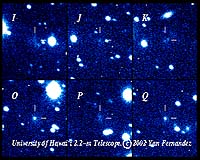
New observations from Mauna Kea with the University of Hawaii’s 2.2-meter telescope by Institute for Astronomy astronomers Yanga R. Fernandez, Scott S. Sheppard and David C. Jewitt have revealed a zoo of tiny mini-comets strung out in a line trailing behind the comet 57P/du Toit-Neujmin-Delporte.
This comet has apparently suffered a significant catastrophe, violent enough to break off many pieces of its nucleus. The event was probably triggered by thermal stresses within the nucleus due to it being warmed by sunlight.
While it is not uncommon for one or two companions to be seen near a comet that has fragmented, our observations reveal at least 19 companions, a rare finding.
Monitoring of these fragments over the coming weeks and months should reveal much about the constitution and fragility of cometary material.
Motivated by an earlier report of a previously-unknown companion associated with Comet 57P/du Toit-Neujmin-Delporte, astronomers at Mauna Kea obtained deep imaging to search for any population of fragments that might exist near the comet.
The astronomers used the University of Hawaii 2.2-m telescope on Mauna Kea and a charge-coupled device (CCD) to make a digital map of the sky around the comet. The observations were performed on the nights of July 17/18 and July 18/19, 2002 (Hawaii Standard Time).
The team found a zoo of fragments strung out in a line extending almost 30 minutes of arc away from the comet itself (for comparison, the diameter of the full Moon also covers 30 minutes of arc). So far the existence of 19 fragments has been confirmed, and the discovery has been announced by the Central Bureau for Astronomical Telegrams, the internationally- recognized official clearinghouse for reporting cometary discoveries.
The various fragments were identified by taking successive images of a field and detecting their motion against the background stars. A mosaic of the relevant mapped region is available online, with the location of the fragments circled. At the distance of the comet, the mosaic spreads over about 1,000,000 kilometers (about 620,000 miles).
At this stage the astronomers are unsure of the sizes of the fragments but estimate that the brightest ones are probably less than a few hundred meters (few hundred yards) across. The smallest fragments are probably no more than a few tens of meters across, roughly the size of a house.
