
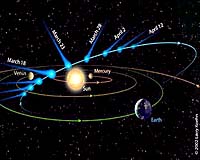
A comet discovered last month by amateur astronomers is making its first pass through the inner solar system in nearly 3-1/2 centuries. Named Ikeya-Zhang [pronounced “ee-KAY-uh JONG”] for the two keen-eyed skygazers who first spotted it, this cosmic interloper can be seen low in the west, not far above the horizon, as soon as it gets dark.
According to Sky & Telescope magazine, the comet is now bright enough to be seen with the unaided eye from very dark sites free of any light pollution.
Binoculars show a bright, starlike nucleus surrounded by a small, faint cloud, or coma. A delicate, wispy tail has been seen pointing away from the Sun, and in time-exposure photographs the tail is already a few degrees long.
The comet’s nucleus appears to be releasing more gas than dust, which is giving the coma and tail a slight bluish cast that is especially noticeable in photographs.
Since Comet Ikeya-Zhang is now moving closer to both the Sun and Earth, it should become several times more obvious by the time its brightness peaks in late March.
“Based on its track record thus far,” notes Sky & Telescope senior editor Roger W. Sinnott, “Comet Ikeya-Zhang stands to be the best comet for northern skygazers since 1997,” when Comet Hale-Bopp put on a command performance. (However, Ikeya-Zhang will not get as bright as Hale-Bopp did.)
The comet will be closest to the Sun, 76 million kilometers (47 million miles, or about half the Sun-Earth distance) on March 18th. It comes nearest to Earth, 60 million km (38 million miles) away, on April 30th.
The comet remains visible to observers in the Northern Hemisphere throughout this period, though it won’t become well separated from the Sun in the evening sky until mid-April, when it is best seen before dawn.
In late April it glides to within 29 degrees of Polaris, the North Star, and remains above the horizon all night for most of the United States and all of Canada and Europe.
Credit for the discovery goes to Kaoru Ikeya (Mori, Shizuoka prefecture, Japan) and Daqing Zhang (Kaifeng, Henan province, China), who spotted the comet on February 1st using their backyard telescopes. At the time it equaled the brightness of an 8-1/2-magnitude star, about 10 times fainter than is discernible to the unaided eye.
“Ikeya and Zhang were lucky,” Sinnott notes. “Today most comets are found by automated professional surveys months before they can be seen in small telescopes.”
Within days of the discovery, astronomers noticed similarities between the orbital path of Ikeya-Zhang (known formally as C/2002 C1) and that of other comets observed in 1532 and 1661. Calculations now strongly suggest this is the object seen in 1661, which is making its first return visit to the inner solar system in 341 years.
No other comet with such a long period has been witnessed on successive orbits around the Sun. (Halley’s Comet, by comparison, comes our way every 76 years or so.)
For more details about the discovery and appearance of Comet Ikeya-Zhang, including a table of astronomical coordinates for its exact location, see:
