
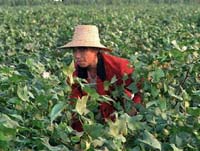
China is planning an expanded focus on the behaviour of flora in space and will build a dedicated seed in the Changxing area of Zhejiang Province, the Zhejiang Daily reported in its Jan. 30 edition.
Changxing County, about 150 km west of Shanghai in the Zhejiang Province in eastern China, recently signed a collaborative agreement with the China Corporation of Aerospace Industry (CCAI) to build the seed nursery and develop associated technologies. Total investment was reported as been 30 million renminbi ($3.6 million U.S.).
Under the agreement, Changxing County will build the nursery and CCAI will take high quality seeds from the nursery for experiments on board satellites. The nursery will be more than 10,000 hectares.
Upon completion it will be the largest in China. First phase of the development, at 2,000 hectares, will start in the near future. The first batch of seeds have already arrived in Changxing.
Since the 1980s, China has carried a variety of seeds in recoverable satellites to study genetic mutation and changes in quality in seeds that are exposed to microgravity, high levels of radiation and magnetic fields in outer space.
Many of the returned space seeds are now planted in experimental farms in Beijing. According to the Zhejiang Daily, substantial prospects exist for the seed market.
Despite the short duration of its highly-publicized maiden flight last November, the Shenzhou capsule also carried various kinds of seeds as souvenirs including: tomato, watermelon, lo bak (Chinese radish), green pepper, corn, barley, wheat, 10 different vegetables, and over 30 different types of herbal plants and compounds.
