
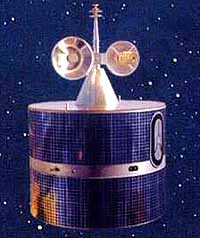
China’s newest meteorological satellite Fengyun-2B (FY-2B) successfully reached its designated orbital slot, Xinhua News Agency reported.
Under the control of the Xi’an Satellite Control Centre (XSCC) in the central Shaanxi Province, FY-2B reached station on Monday (July 3) at 9:28 p.m. Beijing Time. The geostationary satellite is now orbiting over the Equator at 105 deg E longitude.
A week ago on June 25 at 7:50 p.m. Beijing Time a Changzheng-3 (Long March-3) rocket lifted off from the Xichang Satellite Launch Center (XSLC), which is in the southwestern Sichuan Province, with the FY-2B on board.
After a period of six months of on-orbit checkout, FY-2B will be handed over to the China Meteorological Administration (CMA) which will manage the operation of the satellite and distribution of data to users.
FY-2B is China’s second geostationary satellite, which replaces its predecessor FY-2A at the same orbital slot. FY-2A was launched on June 10, 1997 and had been functioning only partially for some time.
Besides transmitting weather images and collecting meteorological, oceanographic and hydrologic data, FY-2B also monitors solar activities such as emission of x-ray and particle radiation. Data from these other instruments will help solar astronomers issue timely information on conditions of the Sun, and warnings of impending solar storm impact.
Last Friday (June 30) the China Youth Daily disclosed that solar storms had damaged the first two FY-1 polar-orbiting metsats and the Dongfanghong-2 and -2A (DFH-2 and -2A) communications satellites.
The FY-1 metsats were launched in September 1988 and September 1990, while the DFH comsats were launched in February 1986 and March 1988.
Zhu Wenming, a researcher on space environment and effects, told the newspaper that bombardment of high energy solar particles caused the four satellites to fail. In the case of the two FY-1, attitude control and other subsystems malfunctioned which disabled the normal operation of the satellites.
All subsequent satellites used as many radiation-hardened components as possible and were tested extensively in simulated space conditions before launching.
The new FY-2B incorporates technical improvement from the previous satellite to enhance its reliability and stability. The design lifetime of FY-2B is three years.
