

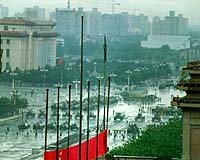
Six months after pledging to lift a 16-year-old arms embargo on China, the European Union has found itself unable to do so largely because of Beijing’s vociferous threats to retake Taiwan by force, analysts say.
European leaders, spearheaded by France and Germany, agreed last December to draft an accord on removing the ban by the end of June, practically promising China that it would go.
But with barely a week left, the chances of lifting the embargo in place since the brutal crushing of the 1989 Tiananmen democracy protests have virtually vanished.
“Americans were pushing the EU to maintain the embargo, but the Chinese pulled the EU in the wrong direction through their anti-secession legislation on Taiwan,” Paul Harris, an expert on Chinese politics at Lingnan University in Hong Kong, told AFP.
The anti-secession law passed in March paves the way for China to take Taiwan by force should the democratic island territory, which has ruled itself independently for the last 55 years, ever formally declare independence.
Passage of the law sent cross-strait tensions rising and alarm bells ringing across the world.
Washington voiced strong opposition to lifting the ban, saying that it would be unpardonable should European weapons end up killing American soldiers if the United States intervened in any potential hostilities in the Taiwan Strait.
“The Chinese had an opportunity there and they missed it, they misread the international circumstances, specifically the circumstances in Europe,” Harris said.
Beijing should have waited a few months more to pass the legislation and they should never have embarked on the saber-rattling rhetoric that accompanied it, Harris said.
Now with Britain, America’s strongest ally, taking over the EU revolving presidency next month there was little chance that the embargo would be lifted in the near future, he said.
In Washington last week a senior official said the ban would not be lifted “anytime soon” and would only be removed after Brussels and Washington reached a common understanding on how to view China’s rise as a political and military force.
“The anti-secession law was a wake-up call for a number of political decision makers in Europe,” said Nicholas Becquelin, the Hong Kong-based director for Human Rights in China.
“It is all very well to think that China will be a benign power, but at the end of the day you have to consider that something will go wrong.”
The passage of the law also reflected the importance to Beijing of the Taiwan issue, especially in comparison to lifting the arms embargo, he said.
“The arms embargo is largely symbolic and for China it is essentially a diplomatic effort aimed at absolution for the Tiananmen massacre and an effort to improve their diplomatic image.”
Beijing still maintains that the crackdown was done in the name of stability and in recent weeks has reiterated that the country would never have been able to enjoy 16 years of robust economic growth had the military not quelled the protests.
Hundreds, if not thousands, of unarmed protesters and citizens were gunned down in central Beijing as the military ended six weeks of unprecedented democracy demonstrations.
Becquelin said that even though the continued implementation of the embargo was decided on military and security concerns, the debate also worked to focus the world’s attention again on the Tiananmen incident.
“We welcome the fact that the arms embargo imposed after June 4, 1989, has not been lifted and continues to be in force,” Becquelin said.
“But it is a pyrrhic victory in a sense because the reason that it remains in force is purely military and security related. The human rights reasons were totally rejected.”
