
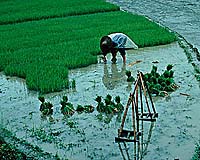
China’s farmers can feed their nation’s growing population by using expanded irrigation to support intense farming techniques, U.S. researchers said.
A team from the Massachusetts Institute of Technology systematically evaluated how water and land limitations affect food production in China. They modeled existing rainfall, climate and land-use patterns, then extrapolated different changes.
Using the land currently being cultivated, China can feed between 1.1 and 1.7 billion people using available farming techniques and drawing on groundwater.
If the same amount of land is irrigated, however, China can feed between 1.3 and 2.0 billion people – probably enough for China’s expected 2030 population of 1.6 billion. The second scenario assumed no use of groundwater because underground reservoirs would be depleted with such an approach.
“This is not an economic analysis. We’re not saying that it’s cost effective for China to feed all these people with domestic production,” said Dennis McLaughlin of MIT’s Department of Civil and Environmental Engineering.
“It might be more cost effective for them to invest in new semiconductor plants and use the income to buy food from Canada.”
