
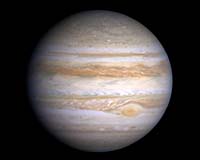
For the first time, scientists have been able to watch the process of two of Jupiter’s giant “white oval” storms, each about half the size of Earth, colliding and merging to form an even bigger storm.
“Usually when we’ve seen two of them approaching each other, they bounce back away from each other,” said Dr. Glenn Orton, senior research scientist at NASA’s Jet Propulsion Laboratory, Pasadena, Calif., and member of a team of Spanish, French and American astronomers that used NASA’s Hubble Space Telescope and ground-based telescopes to study the ovals this year.
Dr. Agustin Sanchez-Lavega, an astronomer at Universidad del Pais Vasco, Bilbao, Spain, reported the team’s observations today at the meeting of the American Astronomical Society’s Division of Planetary Sciences in Pasadena.
The researchers speculate that a similar merger took place centuries ago and may have built Jupiter’s famous Great Red Spot, a storm that is twice as wide as the Earth and has persisted in Jupiter’s southern hemisphere for more than 300 years.
Seeing the collision of two storms will help scientists understand more about the dynamics of Jupiter’s atmosphere, Sanchez-Lavega said. One question has been how deeply the roots of a storm at Jupiter’s cloud tops extend into lower layers. In this year’s merger, the upper layer seemed to move differently than underlying clouds.
