
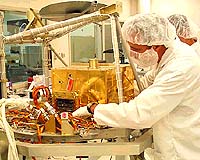
Canada’s first science satellite in over thirty years, SCISAT-1, was unveiled today at a ceremony at Magellan Aerospace’s Bristol facility in Winnipeg. Scheduled for launch on January 19, 2003, SCISAT-1 will help a team of Canadian and international scientists improve their understanding of the depletion of the ozone layer, with a special emphasis on the changes occurring over Canada and in the Arctic.
Dr. Rey Pagtakhan, Minister of Veterans Affairs, Secretary of State for Science, Research and Development and senior federal minister for Manitoba, on behalf of Allan Rock, Minister of Industry, joined Marc Garneau, President, Canadian Space Agency and Jim Butyniec, Vice President and General Manager, Bristol Aerospace, together with Professor Peter Bernath, University of Waterloo and Dr. Tom McElroy, Environment Canada to explore the leading-edge technology that will improve our scientific understanding of the complex atmospheric changes that are occurring, particularly, in the far north.
“SCISAT-1 is an excellent example of how universities, government and industry are working together to drive the design of innovative technologies and support leading-edge scientific research,” said Dr. Pagtakhan. “This research addressing ozone depletion — a major concern for all Canadians — will help to improve our quality of life.”
“We are very proud of SCISAT-1. It is a milestone in space science innovation and will have a major impact on all Canadians, including generations to come,” said Marc Garneau, President of the Canadian Space Agency.
“Our investment in this all-Canadian science satellite is helping Canada become a leader in environmental science and technology, moving us one step closer to improving our understanding of humanity’s interactions on the environment.”
“The benefits of programs like SCISAT-1 reach well beyond the walls of Bristol, where the manufacturing and integration work is carried out,” explained Jim Butyniec, Vice President and General Manager, Bristol Aerospace.
“The Canadian space industry grows in knowledge and experience from the process of developing the new capabilities required to carry out this mission in support of the scientific community. Bristol is proud to play such an important role in building and launching the first small satellite bus in Canada in more than a generation.”
The scientific goal of the SCISAT-1/ACE (Atmospheric Chemistry Experiment) mission is to measure and understand the chemical processes that control the distribution of ozone in the Earth’s atmosphere, particularly at high latitudes.
The data, recorded as SCISAT-1 orbits the Earth, will provide Canadian and international scientists with improved measurements relating to global ozone processes and help policy makers assess existing environmental policy and develop protective measures for improving the health of our atmosphere and prevent further ozone depletion.
The ozone research to be undertaken by the SCISAT-1 mission will be headed by Professor Peter Bernath of the University of Waterloo, who leads a scientific team of researchers from around the world. The Fourier Transform Spectrometer (ACE-FTS), built by ABB Bomem of Qu¿bec City is the primary instrument selected for the Atmospheric Chemistry Experiment (ACE) mission onboard SCISAT-1.
A second instrument, built by EMS Technologies of Ottawa, Measurements of Aerosol Extinction in the Stratosphere and Troposphere Retrieved by Occultation (MAESTRO), will also fly on the SCISAT-1 satellite. Dr. Tom McElroy of Environment Canada is the principal investigator for MAESTRO, with support received from Professor James Drummond of the University of Toronto.
