

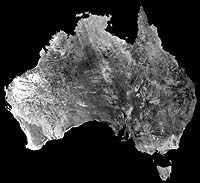
A mosaic of Australia taken by Radarsat-1, the renowned Synthetic Aperture Radar (SAR) satellite operated by the Canadian Space Agency (CSA), was presented today to conference delegates attending the International Geoscience and Remote Sensing Symposium (IGARSS) in Sydney, Australia.
“The absolutely outstanding results of the Australia mosaic,” said Surendra Parashar, CSA Director of Satellite Operations, “reaffirms our commitment to pursue similar projects that will continue to enhance the knowledge, understanding and protection of our global resources and environment.”
The Australia mosaic, a compilation of 165 images captured from mid-November 2000 to mid-February 2001 demonstrates the timely and detailed observation capacity of Radarsat-1 and the expertise of Radarsat International who, in a joint project with the CSA, processed the high-resolution data required to create the Australia mosaic.
“We are very happy to have worked with the CSA to produce this mosaic. By creating the mosaic of Australia we now have a “baseline” from the winter 2000-2001 against which users can perform future change detection studies. For example, the mosaic can be used as a reference point to look at changes in urbanization, desert encroachment and coastline morphology”, said Roland Knight, President of Radarsat International.
Radarsat-1 provides Canada and the world with an operational radar satellite system capable of delivering timely and critical data to assist disaster relief and emergency rescue efforts while also delivering the information required by commercial and scientific users in the fields of agriculture, cartography, hydrology, forestry, oceanography, ice studies and coastal monitoring.
The first such map ever produced of Australia by an Earth Observation satellite, the Australia mosaic is part of an on-going project of the Canadian Space Agency, which has generated the production of mosaics of Antarctica, Canada, the United States and now Australia. Currently underway is the comprehensive data mapping of Africa which is projected for completion in 2002.
