

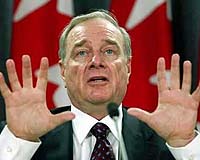
Canada said Thursday it will not participate in a US plans to deploy a missile defense shield covering North America.
The announcement by the Canadian government could chill relations between
Ottawa and Washington. Relations had appeared to warm of late after cooling
with the US-led invasion of Iraq in early 2003, which Canada had also declined to participate in.
Political analysts expected the decision. Ottawa had been mulling its stand on the US missile defense program for more than a year.
Liberal Prime Minister Paul Martin leads a minority government and his
party’s lawmakers had lobbied him not to take part in the program which is
highly unpopular in Canada, particularly in Quebec.
“Let me be clear: we respect the right of the United States to defend
itself and its people. Indeed, we will continue to work in partnership with
our southern neighbors on the common defense of North America and on
continental security,” Martin said.
“However, ballistic missile defense is not where we will concentrate our
efforts. Instead we will act both alone and with our neighbors on defense
priorities such as those outlined in yesterday’s budget. These include:
strengthening the security of our common border, bolstering security at points of entry, reinforcing our coastal and arctic sovereignty, increasing support for intelligence, expanding our armed forces and increasing our capital investment in helicopters, trucks, aircraft and ships,” Martin said.
In Washington, a State Department official, who spoke on condition of
anonymity, said: “The Canadians have informed us of their decision. We take
note of it.”
“We certainly hope that despite the decision we’ll still be able to
continue our broad range of cooperation on bilateral issues, including on
defense cooperation,” the US official said.
“Canada remains steadfast in its support of NORAD, which is essential to
continental security and our national sovereignty,” Martin stressed.
“That’s why we agreed last summer to enhance our longstanding commitment to track missiles through NORAD. We stand by that commitment. It underscores an
important ongoing partnership with the United States and most of all, it is in Canada’s strategic national interest.”
The United States and Canada agreed last August to extend the North
American Aerospace Defense Command’s (NORAD’s) aerospace warning function to
support missile defense.
The agreement allowed NORAD information on incoming missiles to be used by
the US missile defense program, but did not require actual participation by
Canadian forces, according to US officials.
Martin added: “Canada recognizes the enormous burden that the United States shoulders when it comes to international peace and security. The substantial
increases made … to our defense budget are a tangible indication that Canada intends to carry its full share of that global responsibility.”
