
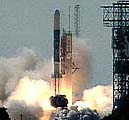
The Canadian Space Agency (CSA) has awarded a contract to MacDonald Dettwiler Associates Limited (MDA) of Richmond, BC to construct and manage RADARSAT II. This second Canadian Earth observation satellite will be a financial and management arrangement between MDA and CSA.
MDA’s winning combination for this project is reflected in its
state-of-the-art design for RADARSAT II, its Business Plan and vision
for the future. MDA will implement an advanced system at half the cost
of RADARSAT I, with a lighter, cheaper and more capable satellite. The
new capabilities will increase data sales and assure the growth of the
value-added Earth observation industry in Canada.
The objectives of the project are to continue Canada’s RADARSAT
program and to develop Earth observation satellite business through a
private sector-led arrangement with the federal government. The project
will result in the construction of an Earth observation satellite (RADARSAT
II) that will provide data continuity to RADARSAT I users and offer data for
new applications tailored to market needs. The Government of Canada
and MDA will invest $225 million and $80 million respectively for the
construction of this high-tech satellite system. MDA will be responsible for
all ongoing operations and data commercialization. Space industry
organizations from across the country will also benefit in the form of
subcontracts to assist MDA. It is estimated that approximately 300 jobs
will be created across Canada over the four-year construction phase of
this project alone.
“Today’s announcement will lead to the launch of the world’s most
advanced Earth observation satellite ever,” said Minister Manley.
“RADARSAT II will confirm Canada’s world leadership in a technology
which will prove critically important to environmental monitoring.”
“This is a great day for British Columbia. RADARSAT II paves the road for
extensive regional development, training and investment,”said Minister
Anderson. “This program makes all Canadians winners as we will be able
to focus on our achievements and placement in a knowledge-based world
economy.”
“This is a good deal for Canada and is the result of a fair competitive
process,” said Minister Gagliano. “RADARSAT II will offer Canada
world-wide market opportunities led by industry and the users to usher
our world class remote sensing capabilities into the next millennium.”
The new satellite, scheduled for launch in 2001, will be the most
advanced Synthetic Aperture Radar (SAR) satellite in the world and will
contribute valuable data to commercial, government and scientific
programs.
RADARSAT is unlike most remote sensing satellites in that it is able to
collect its images through a powerful microwave Synthetic Apature Radar
(SAR) satellite system which provides all-climate, day and night imagery
to clients around the world. The data images, which RADARSAT collects,
have proven to be an effective tool in the management and monitoring of
the global environment in areas of ice navigation, cartography, geological
exploration, maritime surveillance, disaster relief operations, agriculture and forestry surveillance.
RadarSat Reports At SpaceDaily
Earth Observation Reports At SpaceDaily
