

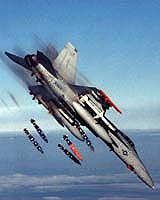
Boeing has successfully demonstrated the capability of a single F/A-18E/F Super Hornet to engage moving land targets during a test at Naval Air Warfare Center, Weapons Division, China Lake, Calif.
“This is just another step in our efforts to develop an all-weather multiple moving target engagement capability for the Super Hornet,” said Chris Chadwick, Boeing vice president for F/A-18 programs.
“We plan to expand on this effort, to meet the goals of precision multiple moving target engagement envisioned in Sea Power 21.”
Real-time targeting updates were accomplished using the aircraft’s existing Digital Communications System (DCS) to communicate over a standard military link to a 2,000-lb.
Joint Direct Attack Munition (JDAM) equipped with a UHF weapon data link module. The weapon data link module included a miniature radio transceiver that transmitted link status back to the aircraft during weapon free-fall.
In the guided release demonstration, the position of the moving target, a radio-controlled panel-side truck, was continuously tracked by the Advanced Targeting Forward-Looking Infrared (ATFLIR) sensor onboard the Super Hornet. Periodic target updates were provided to the JDAM throughout the weapon’s flight to the target.
As a result, the F/A-18 weapon system successfully guided the inert bomb to within two meters of the moving target – close enough to destroy most moving targets.
During a previous flight, two-way UHF link connectivity was verified to 40 miles between a ground-mounted JDAM and aircraft in flight. The UHF weapon data link exceeded expectations in maintaining communications between the F/A-18 aircraft and the JDAM during weapon deployment.
Further demonstrations of the Super Hornet’s future precision engagement capabilities are planned for later this year and 2006.
