
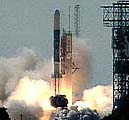
A Boeing Delta II 7920 successfully delivered NASA’s Advanced Composition Explorer (ACE) observatory at 10:39 a.m. EDT to an elliptical transfer orbit in preparation for its one million-mile journey. ACE then will use its
own propulsion system to establish an orbit between the Earth and the sun. This is the second launch under the Boeing name and the first from Cape Canaveral.
The Advanced Composition Explorer will study space matter
including the solar corona and galactic matter. Study of
the energetic particles may contribute to our
understanding of the formation and evolution of the solar
system. ACE also will provide near-real-time monitoring
of solar wind that will allow advanced warning of
geomagnetic storms. From ACE’s position in orbit, the
observatory will have a prime view of the Sun and beyond
the galaxy. ACE has a two-year minimum mission lifetime
and a goal of five years.
“The success of today’s Delta II launch marks another
historic role launch vehicles have played in the
scientific arena,” said Darryl Van Dorn, Boeing director
for NASA and commercial Delta programs. “The Delta II
team is very enthusiastic in its involvement with over 70
of NASA’s scientific missions.” This is the ninth of 10
firm launches encompassed in NASA’s 1990 Medium
Expendable Launch Vehicle Services (MELVS) contract with
five options remaining. Under a second contract, the
Medium Light Expendable Launch Vehicle Services (Med-
Lite) contract for a medium-light class of NASA
satellites, a scaled-down Delta II is scheduled to launch
six missions. The six missions scheduled are: Far
Ultraviolet Spectroscopy (FUSE), Mars Orbiter-2, and Deep
Space-1 in 1998; and Mars Lander-1, STARDUST and EO-
1/SAC-C in 1999. Eight options remain in the Med-Lite
contract. Earlier this week a Boeing Delta II launched
five IRIDIUM” system satellites from Vandenberg Air Force
Base, Calif., completing one-third of the 66 satellite
constellation.
Subcontractors contributing to the Delta II launch
vehicle include the Rocketdyne Divison of Boeing, Canoga
Park, Calif., for the main engine, Alliant Techsystems,
Magna, Utah, graphite epoxy motors for boost assist;
Aerojet, Sacramento, Calif., second-stage engine; and
Allied Signal, Teterboro, N.J., Redundant Inertial Flight
Control Assembly.
