
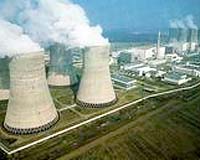
The prime ministers of the three Baltic states of Lithuania, Estonia and Latvia gave their backing on Monday to the construction of a new nuclear power plant in Lithuania. After holding talks in the Lithuanian resort of Trakai near Vilnius, Prime Ministers Algirdas Brazauskas of Lithuania, Andrus Ansip of Estonia and Aigars Kalvitis of Latvia issued a joint statement saying they “support the initiative to build a new nuclear power plant in Lithuania.”
The new plant is to replace an ageing nuclear power station in Ignalina, Lithuania, which has two RBMK reactors, the type that exploded at Chernobyl in the then-Soviet Union in 1986, provoking the world’s worst nuclear disaster.
One of the reactors at the Ignalina plant was halted on December 31, 2004 in line with commitments made by Lithuania to the European Union ahead of accession. The three Baltic states joined the EU in May 2004.
Lithuania also pledged to the EU to close the plant completely in 2009.
Latvia’s Kalvitis told a press conference after the meeting: “The idea of today’s meeting is to develop new production capacities, to build a large-scale power station in the shape of a new nuclear plant in Lithuania, and in so doing, to ensure security and supplies of independent electricity for the next 15 to 20 years.”
Estonia’s Ansip said: “One of our aims is to diversify our sources of energy. This is why we are interested in building a new nuclear power station at Ignalina.”
The three prime ministers invited Baltic national energy companies to invest in the project.
Nearly half of Lithuania’s 141 lawmakers are in favour of allowing the Ignalina plant to continue operating well beyond its scheduled closure, until 2016-17, to allow enough time to build a new nuclear plant.
The lawmakers have argued that, without a replacement plant for Ignalina, Lithuania would face “huge problems with energy.”
Last month, the three Baltic states agreed to launch a feasibility study on building a new nuclear power plant.
“It is clear that from 2015 all the Baltic states will face a shortage of energy and one of the ways to solve the problem is a new nuclear plant,” Lithuanian Economy Minister Kestutis Dauksys had said.
Source: Agence France-Presse
