
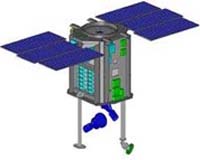
Ball Aerospace & Technologies has been selected by NASA’s Goddard Space Flight Center (GSFC) for the first phase of a study to develop a satellite bus designed for the Global Precipitation Measurement (GPM) mission. The study will conclude in November, in anticipation of final selection by NASA in January 2005.
The selection will be made through the Goddard Rapid Spacecraft Development Office (RSDO). Ball Aerospace has been selected for three RSDO contracts in recent years, including the spacecraft for the Quick Scatterometer (QuikSCAT); the Ice, Cloud and Land Elevation Satellite (ICESat); and the NPOESS Preparatory Project (NPP). The Ball Aerospace Commercial Platform 2000 (BCP 2000) was selected for all three missions.
GPM is a joint mission with the Japan Aerospace Exploration Agency (JAXA) and other international agencies. It is one of the next-generation of systematic measurement missions that will calculate precipitation, a key climate factor, with improved temporal resolution and spatial coverage.
“We have shown that we can accommodate specific program needs within the context of the RSDO offering,” said Zubin Emsley, director of commercial program development for Ball Aerospace. “Successful builds on the already launched QuikSCAT and ICESat make this a good fit for us.”
Ball Aerospace has been involved in the development of instrumentation for this mission for several years. In 2003, Ball Aerospace was awarded a study contract from Goddard for the Global Precipitation Measurement — Microwave Imager (GMI), to fly aboard the GPM spacecraft. This instrument will complement the JAXA contributions, making radiometric and radar measurements of clouds and precipitation.
GPM will build upon the success of the Tropical Rainfall Measuring Mission (TRMM) with a goal of improving weather and precipitation forecasts through more accurate measurement of rain rates and latent heating; and to provide more frequent and complete sampling of the Earth’s precipitation.
