
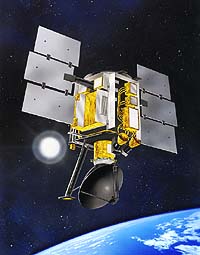
The automation of the Quick Scatterometer (QuikScat) Mission Operations Center (MOC) has been completed enabling satellite monitoring to automated by software systems, as opposed to requiring personnel on hand, for all daily passes except for its two commanding passes.
There are approximately 15 contacts per day between QuikScat and the MOC, one roughly every 101 minutes. The MOC is operated under a subcontract agreement to Ball Aerospace through the University of Colorado’s Laboratory for Atmospheric and Space Physics (LASP).
QuikScat, built by Ball Aerospace from its Ball Commercial Platform 2000 (BCP 2000) standard bus for NASA/Goddard Space Flight Center, was launched last June after being built in a record 11 months.
The completion of its MOC automation procedures is also quick by industry standards, achieved after four months of development followed by four months of fully staffed testing.
“Not only is QuikScat a successful real-time example of NASA’s ‘faster, better, cheaper’ mandate, it also proves the reliability of the system architecture of the BCP 2000 bus and its data reporting capabilities,” said Chip Barnes, Ball’s QuikScat program manager.
“The seamless compatibility between the BCP 2000’s satellite operations and its mission operations is a unique feature of our BCP 2000 bus. We will continue to take advantage of the greater efficiencies this system offers as we operate NASA’s ICESat and other future BCP 2000 missions.”
“We have great confidence in the MOC system,” said Ball’s Marda Barthuli, QuikScat mission operations manager. “The BCP 2000 spacecraft does a very good job of reporting its own status, indicating exactly what’s going on without requiring very much additional data processing.
“LASP’s software immediately detects any anomalies in either the flight or ground systems which can then result in an automatic alarm alert condition.
“The alert system sends pages to on-call personnel who then determine appropriate responses. The automated system has proven itself to be very reliable and it’s never missed detecting a real alarm condition,” said Barthuli.
QuikScat continues to collect and provide unprecedented sea-surface wind vector information for NOAA and the science community.
