
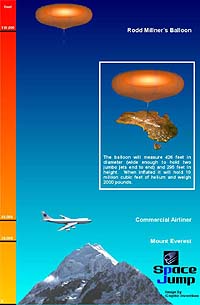
Ex-commando Rodd Millner is planning to jump from the edge of space and parachute 130,000 feet (40 km) back to Earth. Millner will free-fall from the vacuum of space, through the frigid air of the earth’s upper atmosphere before finally descending to earth.
During his descent, where he will reach a speed of between 1600-1800 kilometers per hour (994-1118 miles per hour), Millner will become the first man to break the sound barrier unaided before opening his parachute to fall safely to earth.
Millner’s adventure, known as “Space Jump,” will be filmed on 70mm film and High Definition video tape to create one a breathtaking giant format film that will be produced by international film company, Becker Entertainment.
In March 2002, Millner will ascend from just outside Alice Springs, in the centre of Australia, in a special high altitude helium balloon manufactured by the Australian Defence Force Academy.
As Millner climbs to the edge of space, he will gain a bird’s eye view of spectacular Uluru (Ayers Rock) in the north east and the magnificent Kakadu in the far north of the Northern Territory.
The special balloon will be the size of two football fields in dimension and could accommodate two jumbo jets side by side.
It will take Millner approximately two and a half hours to ascend to 130,000 feet (40,000 metres) in his special balloon before taking less than 10 minutes to parachute to earth.
Wearing a special high-tech suit, Millner will become the fastest unaided man, the highest skydiver, the longest free-faller and the highest balloonist ever to live.
The Space Jump project has been 12 months in its research and development and will be managed by some of the most experienced high altitude balloon operators in the world.
Using the latest robotic and film technology, Millner’s special Space Jump suit will be equipped with a series of cameras to film his extraordinary experience.
In addition, there will be special remote controlled cameras mounted to the balloon gondola, along with additional hot air balloon platforms at 10,000, 20,000 and 30,000 feet (3048, 6096 and 9144 metres). Next a high altitude Lear Jet will conduct filming up to 40,000 feet (12,192 metres), and which will be joined by a team of sky divers filming from 40,000 feet.
Project Director of Space Jump, Walt Missingham, said the project has already seen millions invested. “We have involved a special team of experts across a wide range of scientific and technological areas to ensure this project is successfully conducted with optimum safety and with spectacular visual effect,” said Missingham.
