

Australia’s environment minister began a last-minute lobbying tour of Pacific island states Tuesday in hopes of halting a bid by Japan and other whaling states to end a 20-year ban on commercial whaling.
Environment Minister Ian Campbell will meet senior ministers in Kiribati, the Marshall Islands and Vanuatu in hopes of securing their support before the International Whaling Commission (IWC) votes next month on lifting the ban.
His tour comes after Japan at the weekend pledged about 400 million US dollars in aid to Pacific nations, ostensibly to garner support for Tokyo’s bid to be a member of the UN Security Council.
But Japan has been accused in the past of using aid to buy support for its ambition to resume commercial whaling, banned under an IWC moratorium.
Australia has taken a leading role in opposing whaling, but Campbell insisted the government would not be offering aid as bribes to the poor Pacific states seen as potential swing votes when the 66-member IWC meets in the Caribbean from June 16.
“Australia quite specifically never links aid to these other votes, that would be a practice we would condemn,” Campbell said before leaving Australia Tuesday.
“What we do is try and win the argument based on science, based on the need for global conservation efforts,” he said.
Last year Kiribati voted with Japan at the IWC meeting, but the pro-whaling lobby fell short of the 51 percent of votes needed to challenge the ban on commercial whaling.
Vanuatu and the Marshall Islands are still not members of the commission, but may be considering signing up and reports in the Australian press have suggested the Marshall Islands would vote with Japan.
While a simple majority will not be enough to overturn current whaling bans, anti-whaling forces have warned it could lead to policy changes that could tend to undermine a protective regime.
Japan officially stopped commercial whaling in 1987 and reluctantly accepted an international moratorium supported by Western countries. Norway is the only country that explicitly defies the ban on commercial whaling.
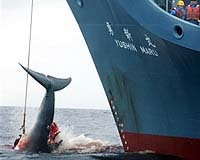
But Japan uses a loophole that allows the killing of whales for “research,” even though the meat usually ends up in grocery stores and restaurants.
Japan last year doubled its annual kill to about 850 minke whales and extended the hunt to other species considered to be endangered. It launched this year’s whale hunt just last week.
