
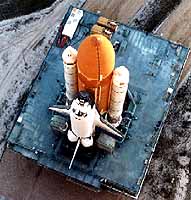
US authorities Tuesday delayed a scheduled launch of the space shuttle Atlantis to later in the week, after high winds stalled the launch of another rocket, pushing the schedule back.
The shuttle, with a team of seven astronauts aboard including Russian cosmonaut Youri Ousachev, is now scheduled to take off Friday on a fourth mission to perform maintenance on the future International Space Station (ISS).
An Atlas III A rocket carrying a European telecommunications satellite was unable to take off Tuesday because of the high winds and is now scheduled to launch Wednesday.
The shuttle launch, originally scheduled for April 13, was postponed to April 24 when Commander James Halsell, who will lead the crew, injured his ankle. It was postponed a second time, until Thursday because of strong winds.
The shuttle’s mission is to take the astronauts to the ISS to prepare it for the arrival of the Russian service module Zvezda scheduled for July, and to load it with equipment for use by crews arriving later in the year. Assembled in December 1998, the space station so far comprises two modules — the US-built section Unity and the Russian module Zarya.
After an eight-minute lift-off, Atlantis is to take two days to reach the ISS and dock at an altitude of 300 kilometers (185 miles).
The astronauts will change three batteries and install fans to prevent the accumulation of polluted air in the Zarya module. Then they will transfer from the shuttle to the ISS one tonne of US and Russian equipment, including computers, exercise equipment and clothing for use by the space station crew later in the year.
The mission is to feature a six-hour space walk in which two astronauts, Jeffrey Williams and James Voss, will secure a mechanical arm that was attached to the exterior of the Unity module during a mission June of last year. There have been problems with the attachment system. They will also install security rails to the exterior of the ISS, to help future maintenance missions, and repair an antenna.
The shuttle will move Zarya and Unity some 32 kilometers (19 miles) further from the earth, as they are losing 2.7 kilometers (1.7 miles) in altitude each week. This orbit maintenance operation will be completed by the Russian service module, Zvezda, scheduled to be launched in July.
Although this will be Atlantis’ 21st mission, the space shuttle has not flown since 1997. A number of upgrades have been made to it, including a reworking of the control panel to make it more effective in crises.
Atlantis shuttle is scheduled to return here on May 29.
