
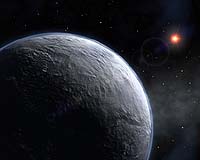
Using a relatively new and much more sensitive technique for detecting distant planetary bodies, astronomers employed a network of telescopes scattered across the globe to find the smallest extrasolar planet to date ¿ and promised to find even smaller bodies in the coming years.
“This now gives people confidence that there are a lot of terrestrial planets out there,” Michael Turner, assistant director of the National Science Foundation’s mathematical and physical sciences directorate, told reporters at a briefing on the discovery.
“The fact that we haven’t seen any before was largely due to the fact that the other two (standard planet-finding) techniques were not sensitive to the smaller planets.”
As described in the Jan. 26 issue of the journal Nature, the observational technique is called gravitational microlensing. It is based on a concept first discussed by Albert Einstein: A star can bend the light passing by from a more distant star, concentrating its intensity for telescopes on Earth just the way a magnifying glass concentrates sunlight.
“With this method, we let the gravity of a dim, intervening star act as a giant natural telescope for us, magnifying a more distant star, which then temporarily looks brighter,” said team member Andrew Williams of Perth Observatory, Australia.
“A small defect in the brightening reveals the existence of a planet around the lens star,” he explained. “We don’t see the planet, or even the star that it’s orbiting; we just see the effect of their gravity.”
Williams said the passage of an intervening star can cause a brightening that lasts about a month, while any planets orbiting that star can produce an additional signal, lasting days for giant planets, or only a few hours for Earth-sized objects.
The newly discovered planet ¿ which they designated OGLE-2005-BLG-390Lb ¿ resembles a giant version of Pluto more than an Earth, Venus or Mars, but at an estimated five Earth masses it is the smallest exoplanet yet discovered. Located about 20,000 light-years away toward the center of the Milky Way, OGLE-2005-BLG-390Lb orbits a star about one-fifth the Sun’s mass at about three times Earth’s distance, making its temperature about minus 220 degrees Celsius. Its surface probably is buried deep beneath frozen oceans.
The Optical Gravity Lensing Experiment ¿ or OGLE ¿ team uses a special camera at the European Southern Observatory’s 1.54-meter instrument at La Silla, Chile, that has been observing 100-million stars at a time in an area of the sky in the direction of the constellation Sagittarius. It can detect about 500 exoplanet candidates per year, according to Jean-Philippe Beaulieu, the Nature paper’s principal author.
“We now expect to find a handful of these objects a year,” Beaulieu told SpaceDaily.com.
In operation for about the past three years, OGLE detected a promising event last July. Team members turned over the information to the other partners in the effort: the telescopes of PLANET ¿ for Probing Lensing Anomalies NETwork. They include the 1.0-meter at Canopus Observatory in Hobart and the Perth 0.6-meter at Bickley, both in Australia; and the Boyden 1.5-meter and the SAAO 1.0-meter in South Africa, as well as the twin 2-meter RoboNet instruments in La Palma, Spain, and Haleakala, Hawaii.
The PLANET telescopes tracked the suspect star for a combined 24 hours a day for about 10 days and compiled a light curve consistent with a single lens star peaking at an amplification of about three times its normal light ¿ and over a 10-hour period noticed a slight deviation that indicated the presence of a planet.
The microlensing technique has turned out to be extraordinarily sensitive, and Scott Tremaine, chair of the astrophysical department of Princeton University, said that under certain conditions OGLE may be able to detect planetary bodies only one-tenth as large as Earth. That would mean finding worlds the size of Saturn’s moons Dione and Tethys.
“Basically, we’re claiming that we’ve opened a new window on the galaxy,” OGLE team member David Bennett of Notre Dame University said at the briefing.
Beaulieu agreed. “OGLE-2005-BLG-390Lb is only the third extra-solar planet discovered so far through microlensing searches. While the other two microlensing planets have masses of a few times that of Jupiter, the discovery of a five-Earth-mass planet ¿ though much harder to detect than more massive ones ¿ is a strong hint that these lower-mass objects are very common.”
