
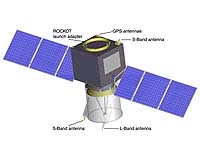
On 27th June, the ESA Industrial Policy Committee unanimously approved the Aeolus mission with Astrium as the proposed contractor for the initial programme. The Aeolus spacecraft, with a mass of about 1 tonne and an expected lifetime of 3 years, is scheduled for launch in October 2007.
Aeolus, named after the mortal appointed by the Greek gods to be keeper of winds, is ESA’s second Earth Explorer Core mission.
Aeolus will carry only one instrument, the Atmospheric Laser Doppler Lidar Instrument (ALADIN), which will provide global observations of wind with a vertical resolution that will satisfy the requirements of the World Meteorological Association in both climate research and operational weather forecasting. At present, accurate global wind profiles are not available and are therefore a major deficiency in the Global Observing System.
Aeolus will be placed in a Sun-synchronous orbit at an altitude of 400 km, enabling it to collect information from anywhere on the planet. The Aladin lidar (laser detection and radar) instrument will create a wind profile showing the relative strength and direction of winds at different altitudes.
Astrium has already been awarded the pre-development contract for ALADIN. Development of the instrument will continue and the integrated pre-development model is scheduled for delivery in the Autumn of 2003.
ALADIN will be the first spaceborne wind lidar offering global coverage. Measurements are taken every 0.1 second and then averaged over 7-second periods (during which time the satellite will have travelled 50km) to obtain wind profiles for altitudes from 0 to 30 kilometers.
The ALADIN instrument is based on the Direct Detection Doppler Wind Lidar concept, which operates in the near UV band (355 nanometres) and uses a telescope for both emission and reception.
It is an active instrument which fires laser pulses towards the atmosphere and measures the Doppler shift of the return signal, backscattered at different levels in the atmosphere.
It combines a fringe-imaging receiver (analyzing aerosol and cloud backscatter) and a double-edge receiver (analyzing molecular backscatter) in a single instrument. The two scattering mechanisms have different spectral properties and wavelength dependencies.
The Aeolus core team is led by Astrium Ltd as prime contractor and includes Astrium SAS with prime responsibility for the ALADIN instrument. Astrium GmBh is responsible for the platform electrical architecture and subsystems while SAAB Ericson Space AB supplies the spacecraft computer.
