
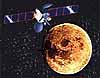
The HGS-1 satellite fired its motor at 5:42 p.m. PDT Thursday, May 7, heading off on its nine-day journey around the moon and back to Earth orbit. This is the first known lunar mission involving a communications satellite and the first mission financed by a non-governmental entity.
Controllers in the Hughes Mission Control Center in El Segundo,
Calif., have confirmed that the spacecraft is on its way, by using
signals received at ground stations and images seen by optical
telescopes around the globe. The satellite reached a maximum speed
of 24,000 mph after the firing to send it on its nearly six-day
outbound trip. On May 13, it will pass behind the moon, coming as
close as 5,000 miles above the surface.
With an assist from lunar gravity, it will swing around the moon,
change directions and head off on its three-day return trip to
Earth. On May 16, satellite controllers will begin braking
maneuvers to help the satellite settle into an orbit around the
equator.
HGS-1 is an HS 601HP model satellite built by Hughes Space and
Communications Co. of Los Angeles. It was designed to provide
television and other telecommunications services for Asia and
neighboring regions. During its launch last Christmas day, however,
the rocket that was carrying it malfunctioned, leaving the satellite
in an unusable, highly inclined, elliptical orbit. The satellite
itself is fully functional, with 44 high-power transponders in C-
and Ku-band.
After the launch failure, the original owner of the spacecraft
filed an insurance claim. The insurers declared the spacecraft a
total loss for its original purposes.
Scientists and engineers from Hughes Space and Comm and its
subsidiary, Hughes Global Services Inc. (HGS), devised a salvage
mission using the moon to move the satellite into a usable circular
orbit. HGS has obtained the title to the spacecraft, with the
agreement to share profits with the insurers if the satellite can be
put to use.
During the last several weeks, Hughes controllers have fired the
satellite’s onboard rocket motor several times to raise its
altitude. Friday’s was the 12th firing, and it burned for almost
two minutes to give HGS-1 its final kick toward the moon.
Controllers may use short burns during the nine-day cruise to make
minor adjustments in the flight path.
The commands for the final firing were sent to the spacecraft
about 2 a.m. PDT Thursday, and HGS-1 executed the maneuver while
out of view from the ground stations. Controllers were able to
confirm the motor firing within about half an hour, and within
another hour verified that HGS-1 was on the correct trajectory.
