
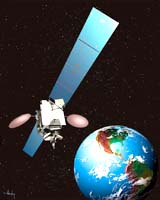
PanAmSat has shipped its third satellite in its seven-satellite expansion and redeployment plan to French Guiana for a mid-April launch.
Galaxy IVR, PanAmSat’s third new satellite for North America in less than four months, will lift off from the Guiana Space Center aboard an Ariane 4 rocket to serve as the permanent replacement for the 99-degree west longitude orbital location. Galaxy IVR will be PanAmSat’s 11th North American satellite and its 21st worldwide.
In addition, Galaxy IVR’s deployment will complete PanAmSat’s satellite expansion and redeployment plan for North America, enabling the migrations of the company’s Galaxy VI, Galaxy VII and Galaxy XI satellites to new orbital locations.
“The upcoming launch of Galaxy IVR demonstrates PanAmSat’s rapid deployment plans for new satellites, building upon the strength of our North American fleet and providing our customers with the most comprehensive and reliable services,” said Robert Bednarek, PanAmSat’s executive vice president and chief technology officer.
“Galaxy IVR will deliver the highest-quality digital and analog video distribution, Internet and telecommunications services throughout the continent.”
Galaxy IVR, an HS 601 HP model spacecraft built by Hughes Space and Communications Co., will employ a communications payload consisting of 24 C-band and 24 Ku-band transponders.
The high-power spacecraft will serve as the primary distribution platform for high-profile video, Internet and telecommunications customers that include National Public Radio, Encore, Hughes Network Systems, NHK and Televisa.
Galaxy IVR will also serve as the broadband pipe for the delivery of AOL Plus direct to consumers’ homes via Hughes Network Systems’ DirecPC satellite Internet service.
In addition, Galaxy IVR will serve as the new platform for PanAmSat’s Galaxy 3DTM service, a bundled domestic digital delivery package offering television broadcasters, programmers and business network managers a one-stop shopping resource for end-to-end digital video, audio and data transmission services among more than a dozen North American cities.
Following the deployment of Galaxy IVR, PanAmSat will turn its focus to its international fleet, deploying four new satellites for international markets.
The company will launch the PAS-1R and PAS-9 Atlantic Ocean Region satellites, the PAS-10 Indian Ocean Region satellite and the Galaxy IIIC spacecraft, serving the United States and Latin America.
The new satellites will bring PanAmSat’s global fleet to 24 spacecraft by mid-2001, the largest network of commercial geosynchronous communication satellites in the world.
