
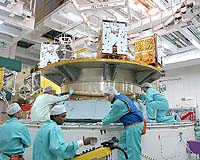
Preparations for Arianespace Flight 165 marked another milestone last week as the mission’s six auxiliary payloads were integrated on the Ariane 5 launcher.
This activity took place in the upper levels of the Spaceport’s Final Assembly Building, where the ASAP 5 auxiliary payload dispenser ring was moved into place atop Ariane 5’s central cryogenic core stage.
ASAP 5 carries the complement of small-sats that are to be deployed during Flight 165: four Essaim spacecraft for the French defense procurement agency (DGA), the Parasol payload from France’s CNES space agency and the Spanish Nanosat.
The Essaim spacecraft were developed for the French defense procurement agency (DGA), and they will be used to validate technologies for a future space-based military electronic intelligence (ELINT) system.
They are generally similar in overall size and appearance Parasol, a 120-kg. small-sat that is to study the impact of aerosols and how they interact with clouds to help scientists better understand the Earth’s climate.
Spain’s Nanosat is the smallest of the auxiliary payloads, weighing less than 20 kg. It is designed to demonstrate the feasibility of applying scaled-down components and sensors in mini satellites.
The Nanosat payload includes extremely small magnetic and solar sensors, along with a store-and-forward communications system that will relay information from remote scientific facilities to a central station in Madrid.
All of these auxiliary spacecraft will be released in sequence following Ariane 5’s deployment of the mission’s primary satellite – the Helios IIA military reconnaissance platform.
Liftoff of Flight 165 is planned for December 10 on a mission to Sun-synchronous orbit.
