
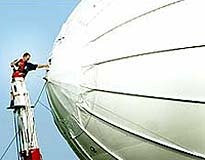
The Air Force Research Laboratory (AFRL) recently awarded two contracts, with a combined value in excess of $15.5 million, to Northrop Grumman in support of its “Integrated Sensor Is Structure (ISIS)” program. ISIS envisions a stratospheric airship operating as a surveillance platform more than 70,000 feet above the Earth.
The goal of the ISIS program is to develop a stratospheric airship-based autonomous unmanned sensor with years of persistence in surveillance and tracking of air and ground targets. It will have the capability to track the most advanced cruise missiles at a distance in excess of 370 miles and dismounted enemy combatants on the ground nearly 200 miles away.
Achieving this goal will require the development of technologies that enable extremely large, lightweight phased-array radar antennas to be integrated into an airship platform. Major technical challenges are the development of ultra-lightweight antennas, antenna calibration technologies, power systems, station keeping approaches, and airships that support extremely large antennas.
Northrop Grumman Space and Mission Systems Corp., Space Technology, Redondo Beach, Calif., was awarded a $6,865,481 contract to develop a direct current efficient transceiver to minimize the prime power requirement of large aperture phased array platform. The contract also calls for engineers to develop a low-cost, low-mass module packaging solution to reduce the overall system weight.
The firm’s Electronic Sensors and System Section at Linthicum Heights, Md., was awarded an $8,667,389 contract to develop a lightweight, low-power density Active Electronically Scanned Array (AESA) technology for the ISIS. The technology will be dual band (UHF and X-Band) and bonded to the flexible hull material of the airship.
“We are investigating four of the critical ISIS technologies here at Rome,” said Jeffery L. Mack, program manager in the AFRL Sensors Directorate, citing active electronically scanned arrays, lightweight/low power transmit/receive (TR) modules, advanced hull material for airships, and prime power for near space environments. “The vision for this stratospheric platform is an array of sensors to create a radar nearly as large as the airship itself.”
Bonnie L. Goetz and Janet M. Olson of the AFRL Information Directorate’s Contracting Division negotiated the Northrop Grumman agreements.
