
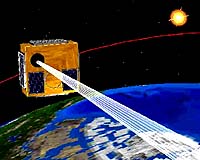
AeroAstro, Inc., a leading provider of small satellites and related technology products, has announced the successful on-orbit operation of its miniaturized S-Band Transmitter product. Two of these compact, lightweight transmitters are being used for primary downlink capability aboard the Canadian Space Agency (CSA) MOST (Microvariability and Oscillations of Stars) satellite, launched on June 30, 2003.
AeroAstro’s transmitters have been functioning as designed since launch, meeting all specifications. This event establishes first flight heritage for this inexpensive transmitter.
AeroAstro’s S-Band Transmitter product is designed to provide an affordable and reliable data downlink from nanosatellites and microsatellites, compatible with virtually any satellite bus system. The transmitter’s small size, measuring only 3″ x 2″ x 1″ (76 mm x 51 mm x 25 mm) with a total mass of 180 grams, as well as its highly competitive cost makes it an ideal solution for satellites tightly constrained by mass, volume and budget.
The transmitter is priced at less than $65k, with opportunities for additional cost savings (price varies based on requirements and level of customization). The output frequency of the transmitter is programmable anywhere in the commercial S-Band range (2200 ¿ 2300 Mhz), and the output power is adjustable from 10 to 500 mW, with an optional high power amplifier (HPA) that enables up to 5 W. The transmitter will work with data rates ranging from 2 kpbs up to 1 Mbps, or up to 10 Mbps with the optional HPA.
Dr. Rick Fleeter, AeroAstro’s CEO, said, “AeroAstro exists to make the benefits of space more widely available and more useful ¿ by lowering cost, shortening schedules and making space simpler to access.
For many clients, that means that we build end-to-end space systems solutions, including a spacecraft and ground stations. But we are pleased to have the opportunity to help others, like the MOST team, innovate their own space systems.
Our growing line of modular products, including the radios flown aboard MOST, are designed to simplify the job of getting the spacecraft built, to shorten the development schedule, and to lower cost without sacrifice of performance.”
The transmitter has a straightforward design for ease of integration and use. Its only interfaces are DC power and data. It requires no external clock ¿ data is simply buffered and filtered to remove noise and processed to produce a BPSK output signal. QPSK can also be accommodated. It can be easily integrated with AeroAstro’s S-Band Receiver, HPA, and DC/DC block for a complete satellite communications solution, or it can stand alone with other radio subsystem components.
In mid-2001, AeroAstro was approached by the University of Toronto Institute for Aerospace Studies (UTIAS) Space Flight Laboratory (SFL) ¿ the provider of several key subsystems for the MOST satellite, including the telemetry and command subsystem ¿ to determine if it was possible to provide two flight-ready S-Band transmitters on a short timescale.
Each of the transmitters was to operate on a different frequency, providing system redundancy for the mission. AeroAstro accepted the contract in July 2001 and delivered two flight transmitters only three months later, in early October of that same year. Thermal vacuum and vibration testing followed at the UTIAS facilities, and final flight acceptance of the transmitters was granted in May 2002.
The MOST project is a co-operative scientific partnership to create the world’s smallest astronomical space telescope, capable of measuring the ages of stars in our galaxy and helping to unlock mysteries of the universe. The tiny satellite, weighing only 60 kilograms, carries a high precision telescope no bigger in diameter than a pie plate.
The device measures the oscillation in light intensity of stars in order to determine their composition as well as age. The MOST project was sponsored by CSA’s Space Science Branch, and Toronto-based Dynacon Enterprises Limited was the lead contractor for the project. Other key partners in the project include: UTIAS/SFL, the University of British Columbia, the Centre for Research in Earth and Space Technology (CRESTech), and the Radio Amateur Satellite Corporation (AMSAT).
