
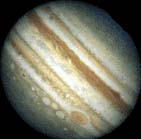
Life may thrive on small planets that have been captured and enslaved as moons by giant planets such as Jupiter, a new computer simulation suggests.
Gas giants similar to Jupiter have been found orbiting close to other stars. But even if they orbit their stars at similar distances to the Earth’s orbit, they would not have the right conditions, such as a rocky surface, to support life as we know it.
Astronomers have suggested that their moons might support life, but that raises another problem. Moons that form in orbit around giant planets are unlikely to grow large enough to have enough gravity to hold onto an atmosphere.
Bertil Olsson, a postgraduate student at Pennsylvania State University in University Park, wondered whether there was another possibility–that a giant planet could capture a nearby Earth-sized planet.
Astronomers believe giant planets that orbit close to a star must have formed in the outer reaches of the solar system, then migrated inwards. They might capture small inner planets as they migrate.
When Olsson ran computer simulations of the inward migration of a giant planet toward a Sun-sized star, he found it could easily capture a terrestrial planet into a stable orbit. “I was surprised by how easily it happens,” he told New Scientist.
The simulations showed that giants up to ten times as massive as Jupiter could capture planets up to ten times the Earth’s mass. Ten times Earth’s mass is thought to be the heaviest a planet can be for life to develop. Olsson described his results last week at a meeting of the American Astronomical Society in Atlanta, Georgia.
However, he has yet to calculate the probabilities of Earth-sized planets being captured into orbit. Although it seems to happen easily, the gravity of large planets can also eject small planets from their systems.
This article appeared in the January 22 issue of New Scientist New Scientist. Copyright 1999 – All rights reserved. The material on this page is provided by New Scientist and may not be published, broadcast, rewritten or redistributed without written authorization from New Scientist.
